
Most marketing teams are not short on data. They are short on understanding.
Your dashboard shows clicks, opens, and bounce rates. It rarely tells you why someone bought, why someone hesitated, or why someone left for a competitor.
That gap is the whole reason customer insights exist.
This guide breaks down what customer insights actually are, why they matter right now, where to find them, and how to turn them into work that moves revenue. No fluff. Just the playbook.
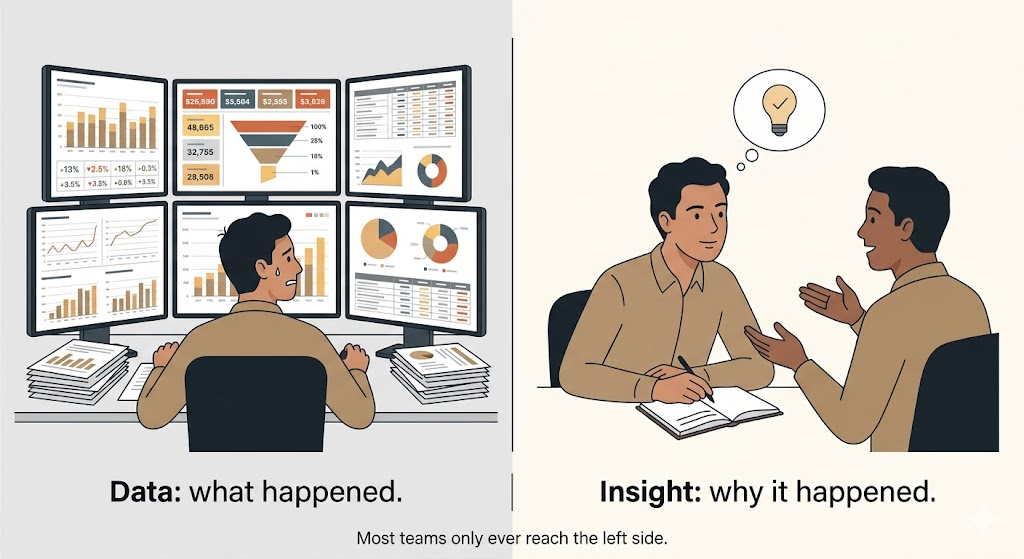
A customer insight is an interpretation of behavior that explains why people act the way they do.
It is not a number. It is the meaning behind the number.
Here is the cleanest way to think about the difference.
The first two are inputs. The insight is the conclusion you can act on.
These two get confused constantly. They are partners, not twins.
Market research collects the facts. Surveys, focus groups, panels, and experiments give you the what.
Customer insights interpret those facts. They reveal the motivations, fears, and triggers that drive the what.
Run them together and you get a chain: gather the data, read the pattern, act on the meaning.
Buyers expect you to know them. The bar keeps rising every year.
McKinsey research shows 71 percent of consumers expect personalized interactions from companies, and 76 percent get frustrated when they do not receive them.
Salesforce found that 63 percent of consumers expect businesses to understand their unique needs and expectations.
That is the demand side. The supply side is where it gets uncomfortable.
85 percent of companies believe they deliver personalized experiences. Only 60 percent of customers agree.
That 25-point gap is the cost of guessing instead of knowing.
Insight-driven marketing is not a soft skill. It shows up on the P and L.
None of that happens without first understanding the person on the other end.
This is the part most guides skip. People are unreliable narrators of their own behavior.
Ask someone if they would buy your product and they often say yes. They want to be polite. Then they never open their wallet.
Two things cause this:
The fix is not to stop asking. The fix is to weight what people do over what they say.
The Superhuman team made this famous. Instead of asking customers if they liked the product, they asked how disappointed they would be if it disappeared.
That question measures dependence, not flattery. Behavior over compliments.
You do not need a research department or a six figure budget. The richest material is usually already around you.
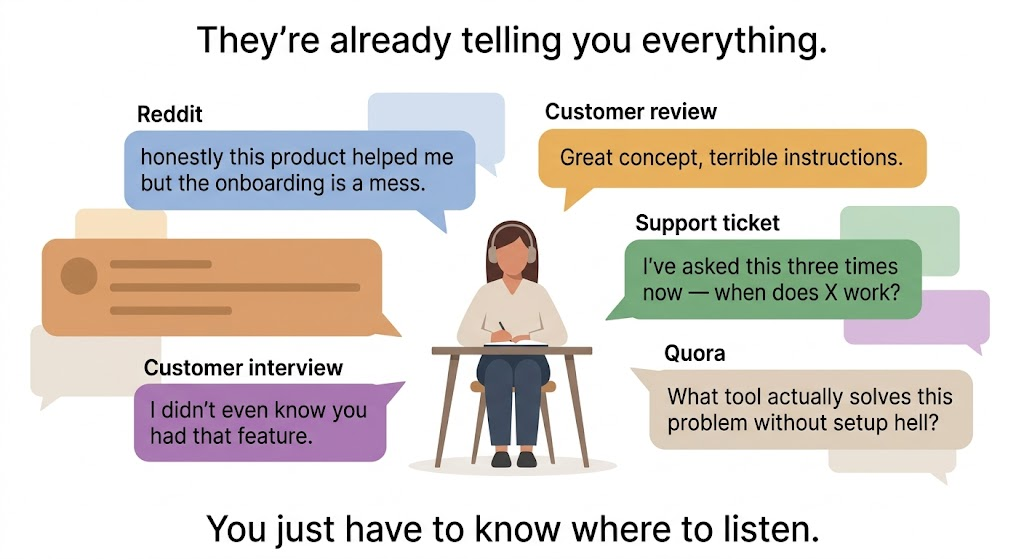
Interviews remain the fastest path to the why. Numbers tell you what broke. A conversation tells you why it broke.
Ask about the last time they faced the problem you solve. Listen for the words they use, not the words you wish they used.
Surveys scale qualitative hunches into quantitative confidence. Use them to size a pattern you already spotted in interviews.
Usage and attitude studies go further. They map how often people use you, how they feel about you, and what stops them from doing more.
Your reviews, chats, and tickets are a transcript of real frustration and real delight. Most teams let them rot in a folder.
Look for repeats. The same complaint from ten people is a roadmap. The same praise is your positioning.
Reviews carry weight with buyers too. G2 reports that 93 percent of consumers say online reviews influence their purchase decisions, and Harvard Business School found a one star Yelp bump can lift revenue by around 9 percent.
This is the underrated goldmine. On anonymous platforms, people say what they would never write on a survey.
Sprout Social calls Reddit a voice of the customer hub built on raw, unadulterated honesty.
The proof is in the threads. Two founders once posted a product concept to a gaming subreddit and pulled over 1,100 comments and 4,600 upvotes of direct feedback, a case documented by Salesforce.
Quora works the same way. The questions people ask reveal the gaps they feel.
On one Quora thread about capturing customer insight, a respondent with a decade of experience described methods ranging from “deep immersion like working alongside the customer” to structured deprivation exercises.
On another Quora thread on why insights matter, one answer put it plainly: “direct feedback from the actual users” shows a company exactly what to improve.
A simple workflow: search your topic with the site colon reddit dot com trick, read for patterns, and save the exact phrases buyers use.
Drop off points, ignored features, and repeat actions are insights in disguise. Behavior does not lie.
Remember that a large share of buying happens offline too. Statista data suggests roughly 40 percent of company and consumer touchpoints are not digital, so analytics alone never tells the full story.
A single average hides the truth. New buyers and loyal buyers often want opposite things.
Combine demographic, behavioral, and attitudinal data so you can speak to each group in its own language.
An insight that sits in a slide deck is worthless. Here is where it pays off.
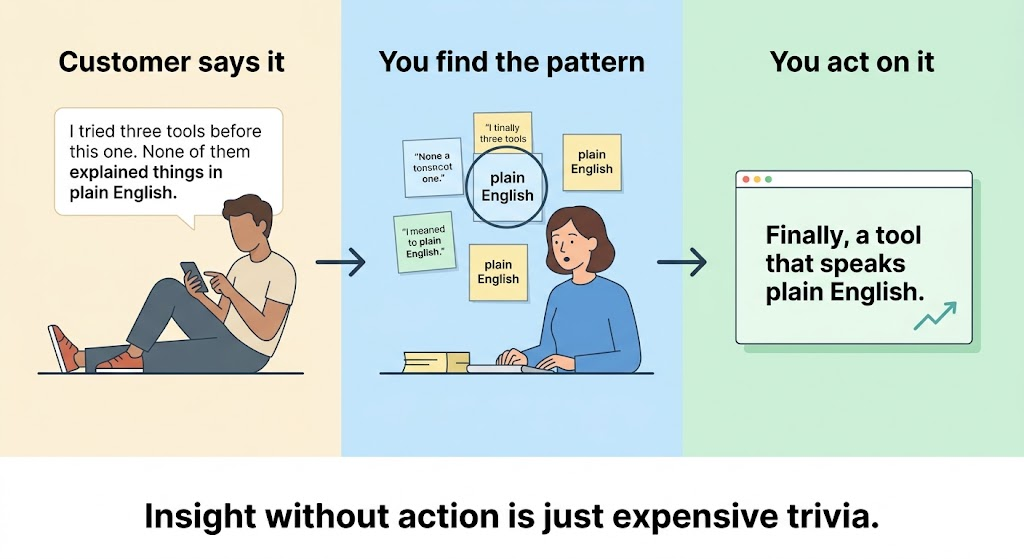
This is Voice of Customer copy. Instead of inventing clever lines, you borrow the language buyers already use.
A complaint like a tool finally not making me feel dumb can become a headline that outperforms anything written in a conference room.
Analytics shows the drop off. Insight explains the cause. Hidden fees, confusing navigation, slow pages.
Solve the cause and you lift conversion without spending another rupee on traffic.
Personalization is not slapping a first name on an email. It is relevance at the right moment.
Replenishment reminders, fit suggestions, and lifecycle based offers all come from reading behavior closely.
Declining logins, unresolved tickets, and cooling engagement are early warning signs.
Act on them before the customer decides to leave. Keeping a customer is far cheaper than chasing a new one.
You can begin without any new tools. Work through these four questions about your buyer.
1. Who are they, beyond age and job title?
2. What do they actually want, and what problem blocks them?
3. How do they solve that problem today, without you?
4. What barriers stop them from choosing you?
Fill those in from interviews, reviews, and forum threads. Patterns will surface fast.
Then pick one insight and ship one change. A new headline, a fixed checkout step, a sharper segment. Measure it. Repeat.
Customer insight is not a research phase you finish. It is a habit you keep.
The brands that win are not the ones with the most data. They are the ones who understand the human behind it.
Listen closely, read behavior honestly, and act on what you find. That is how you stop guessing and start building marketing people actually respond to.