AI-ready or AI-adjacent: Is your Marketing agency equipped to scale?
AI is no longer a side experiment inside marketing agencies. It is becoming part of daily operations, client delivery, reporting, campaign planning, and content production. The real question now is not whether agencies use AI. It is whether they are built to scale with it.
Across industries, AI adoption is moving faster than most agencies expected. According to Jasper’s 2026 State of AI in Marketing report, 91% of marketers now actively use AI in their work, up from 63% last year.
The shift is no longer limited to content generation. Marketing teams are using AI for workflow automation, predictive targeting, reporting, campaign optimization, and operational efficiency. Adobe reports that 88% of digital marketers now use AI in day-to-day activities.
At the same time, AI-native agencies are entering the market with smaller teams, faster execution cycles, and lower operational overhead. Traditional agency models built around manual execution are starting to feel slower, heavier, and harder to scale.
This creates a new divide in the industry. Some agencies are becoming AI-ready. Others remain AI-adjacent. The difference between the two may shape who grows over the next few years.
Table of Contents
Why This Conversation Matters Now
Client expectations are shifting faster than agency operating models. Brands now expect agencies to move with the speed of in-house teams while still delivering strategic thinking, creative quality, and measurable growth.
Rising client expectations
Clients no longer measure agencies only by campaign output. They also evaluate speed, personalization, reporting quality, and responsiveness.
Faster campaign launches and revisions are now expected across channels.
Brands want deeper personalization without increasing budgets.
Real-time reporting and performance visibility are becoming standard expectations.
Over 80% of marketers already use AI for content and campaign workflows.
Pressure on agency margins
Most agencies are handling more deliverables without proportional team growth. This creates operational pressure, especially for firms still dependent on manual workflows.
Content demand continues to rise across paid, organic, email, and video channels.
Teams are expected to produce more campaigns with leaner resources.
AI-native firms operate with smaller teams and lower delivery costs.
McKinsey data shows only a small percentage of firms see real AI returns despite widespread adoption.
Faster campaign cycles
Marketing cycles that once ran monthly or quarterly are now compressed into days. Agencies must react quickly to trends, audience behavior, and platform changes.
Brands expect rapid testing, optimization, and iteration.
AI-assisted workflows are shortening content and reporting timelines.
Daily campaign adjustments are becoming common in performance marketing.
87% of marketers now use generative AI in recurring workflows.
AI-native competitors are entering the market
A new generation of agencies is being built around automation-first operations. These firms are not adapting old systems. They are starting with AI at the center.
Smaller teams can now deliver work previously handled by large departments.
AI-assisted production reduces turnaround time across creative and operations.
Workflow automation helps these agencies scale without major hiring expansion.
Gartner predicts AI agents will appear in 40% of enterprise applications by 2026.
This shift is creating a clear divide in the agency market. Some agencies are experimenting with AI tools. Others are restructuring their entire operating model around AI-assisted execution.
What Is an AI-Adjacent Agency?
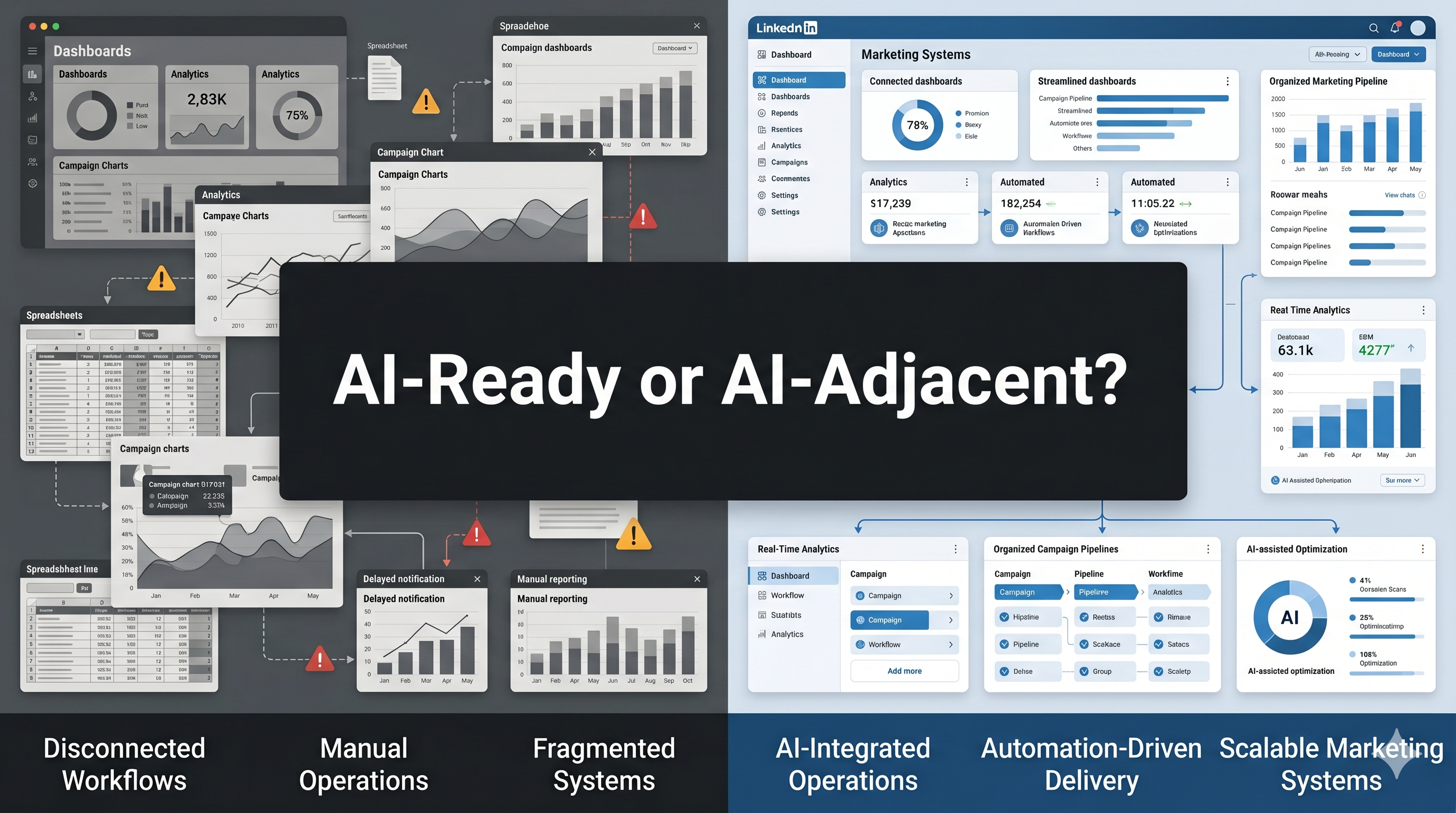
An AI-adjacent agency uses AI tools regularly but still operates with older workflows, disconnected systems, and manual delivery structures. AI exists inside the agency, but mostly as a support tool rather than part of the core operating model.
Many of these agencies appear modern because teams use ChatGPT, automation tools, or AI design platforms. However, the actual execution process often remains slow, fragmented, and heavily dependent on human coordination.
Prompt-heavy usage without workflow changes: Teams use AI to generate blogs, captions, ad copies, or ideas, but the larger delivery process remains unchanged. Approvals, revisions, reporting, and campaign execution still move through slow manual systems.
Disconnected AI tools across departments: Writers, designers, strategists, and marketers often use different AI tools independently. Since there is no unified process, teams end up working in silos instead of a connected workflow.
Manual reporting and repetitive operations: Teams may save time on content generation while still spending hours compiling reports, updating spreadsheets, and managing repetitive operational tasks manually.
No structured AI direction: AI adoption depends more on individual employee interest than agency-wide planning, training, or operational standards.
Scaling challenges continue: Even after AI adoption, agencies still require additional manual effort and hiring to manage growth because the underlying workflow structure was never redesigned.
What Makes an Agency AI-Ready?
An AI-ready agency does not treat AI as a side tool for faster content creation. It builds processes, delivery systems, and operational decisions around AI-assisted execution. The difference becomes visible in how work moves across teams, how quickly campaigns launch, and how consistently output is delivered at scale.
These agencies focus less on collecting tools and more on building connected systems that reduce operational friction.
AI-integrated workflows: AI is embedded directly into campaign planning, content production, approvals, reporting, customer communication, and optimization processes. Teams work inside connected systems instead of isolated tasks.
Automation-first operations: Repetitive work such as reporting, campaign monitoring, task assignment, lead routing, and status updates is automated wherever possible. This allows teams to spend more time on strategy and client-facing work.
AI-assisted reporting and analysis: Reporting is no longer a manual weekly activity. AI helps agencies process campaign data faster, identify trends earlier, and generate performance insights without spending hours inside spreadsheets.
Scalable content operations: Content production is structured around repeatable systems. Agencies can produce blogs, ads, landing pages, email campaigns, and social content across multiple clients without creating operational chaos internally.
Agentic workflows across departments: Instead of relying entirely on human coordination, agencies use AI agents and automated workflows to manage research, task execution, content refinement, campaign monitoring, and internal collaboration.
Data-driven decision making: Campaign decisions are based on performance signals, customer behavior, testing patterns, and operational data instead of assumptions or delayed reporting cycles.
Governance and quality control: AI-ready agencies establish review processes, content standards, approval systems, and usage policies to maintain consistency, compliance, and output quality across teams.
Most importantly, AI-ready agencies redesign how work happens. They do not simply add AI tools into old agency structures.
The Biggest Signs Your Agency Is Not Ready
Many agencies believe they are adapting to AI because teams use ChatGPT, automation apps, or AI-powered design platforms. But daily operations usually reveal a very different picture.
If teams still spend large portions of the day handling repetitive coordination work, the agency may only be adding AI on top of old systems instead of improving how work actually moves.
Some of the most common warning signs include:
Teams repeat the same manual tasks daily: Campaign updates, reporting, approvals, file organization, and status tracking still consume hours every week. AI may speed up small tasks, but operational inefficiencies remain untouched.
Reporting still takes days to complete: Teams manually pull data from different platforms, clean spreadsheets, and prepare presentations instead of using connected reporting systems.
AI-generated work lacks review standards: Different team members produce completely different quality levels because there are no structured review processes, brand guidelines, or output standards for AI-assisted work.
There are no standard workflows across departments: Each team operates differently, making collaboration slower and harder to scale as client demands increase.
In many agencies, AI adoption also depends too heavily on individuals instead of systems.
No structured AI training process exists: Employees learn tools independently without company-wide guidance, operational policies, or shared best practices.
Teams use random tools independently: Multiple subscriptions exist across departments with little coordination, integration, or workflow consistency.
Delivery depends too much on specific employees: When critical work relies on individual experience instead of repeatable systems, scaling becomes difficult and operational risk increases quickly.
These problems usually signal that AI adoption is happening at the surface level rather than inside the agency’s operational foundation.
The New Agency Model Emerging
A different type of marketing agency is starting to take shape. These firms are not built around large execution teams, long production timelines, or heavily layered approval structures. Instead, they operate with smaller teams, connected systems, and AI-assisted execution across daily operations.
This shift is changing how agencies scale, how quickly campaigns move, and how clients evaluate performance.
Lean AI-native agencies: Many newer agencies are entering the market with fewer employees but higher operational output. Instead of expanding through large hiring cycles, they rely on automation systems, AI-assisted production, and structured workflows to manage client growth efficiently.
Hybrid human + AI teams: Human teams still lead strategy, creative direction, relationship management, and decision-making. AI handles repetitive execution, research support, reporting assistance, first-draft generation, and operational coordination behind the scenes.
Agentic operations becoming practical: Agencies are starting to experiment with AI agents that can handle recurring tasks such as campaign monitoring, data analysis, workflow routing, content refinement, and internal task management with minimal supervision.
Google recently described this industry movement as the beginning of the “agentic era,” where AI systems move beyond simple assistance and start managing multi-step operational tasks more independently. (blog.google)
Faster delivery cycles: Campaign adjustments that once required several meetings and multiple handoffs can now move much faster through AI-assisted coordination and production systems.
Scalable personalization: Agencies can now produce personalized campaigns, audience variations, localized messaging, and dynamic content at a scale that was previously difficult for smaller teams to manage manually.
The agencies adapting to this model are not simply working faster. They are changing how marketing operations function altogether.
AI Readiness Assessment Framework
Beginner Level: AI usage is limited to basic content generation, brainstorming, or small productivity tasks. Teams experiment individually, but there is no operational strategy, workflow integration, or leadership direction behind adoption.
Strategy Check: The agency has no clear vision for how AI supports growth, service delivery, profitability, or client experience. AI is treated as a temporary productivity tool rather than part of business operations.
Experimental Level: Teams actively test AI tools across content, design, reporting, or research tasks, but usage remains fragmented across departments without standard processes.
Workflow Automation Check: Repetitive tasks such as reporting, approvals, campaign updates, or task management still depend heavily on manual effort and disconnected systems.
Team Enablement Check: Employees learn AI tools independently without structured onboarding, internal documentation, or shared best practices across the organization.
Operational Level: AI becomes part of daily execution. Teams use connected workflows, shared systems, automated reporting, and standardized review processes to improve delivery speed and consistency.
Data Systems Check: Campaign data, reporting systems, CRM platforms, and operational tools work together instead of existing in isolated silos.
QA and Governance Check: The agency has clear review standards, approval systems, compliance guidelines, and quality controls for AI-assisted work.
AI-Ready Level: AI supports strategy, execution, reporting, personalization, and operations through structured systems fully integrated into client delivery.
Final Thoughts
The agency industry is moving into a different operating model. AI is no longer limited to faster copywriting or quick productivity gains. It is starting to shape how agencies manage workflows, reporting, campaign execution, and client delivery at scale.
The agencies likely to grow faster over the next few years may not be the ones using the most AI tools. They may be the ones building stronger systems around AI-assisted operations.
Using AI occasionally is no longer enough. The real advantage now comes from connected workflows, faster execution, operational consistency, and the ability to scale without increasing complexity at the same pace.
Frequently Asked Questions (FAQs)
What is an AI-ready marketing agency?
An AI-ready marketing agency uses AI across workflows, reporting, operations, campaign management, and delivery systems instead of limiting AI to content generation or isolated tasks.
What is an AI-adjacent agency?
An AI-adjacent agency uses AI tools occasionally but still relies heavily on manual processes, disconnected systems, and traditional operational structures.
Can small agencies become AI-ready?
Yes. Smaller agencies can often adapt faster because they have fewer layers, simpler workflows, and greater operational flexibility compared to large organizations.
Does becoming AI-ready reduce the need for human teams?
No. Human teams still handle strategy, creative direction, relationship management, and decision-making. AI mainly reduces repetitive operational work.
What are the biggest signs an agency is not AI-ready?
Common signs include manual reporting, disconnected AI tools, inconsistent quality control, lack of workflow automation, and heavy dependence on specific employees.
Why are AI-native agencies growing quickly?
AI-native agencies operate with leaner teams, faster delivery systems, automated workflows, and lower operational overhead, allowing them to scale more efficiently.
Is using ChatGPT enough to make an agency AI-ready?
No. Using ChatGPT alone does not change operational systems, workflows, reporting structures, or delivery processes inside the agency.