Most people who buy from you decided you were worth a look long before they filled out a form. They searched, compared notes, and quietly shortened their list while your team had no idea it was happening.
By the time someone books a call, around 83 percent of their buying journey is already behind them. Your content and your reputation did the selling while you were looking the other way.
A customer journey map is how you pull that hidden stretch back into view. It lays out what people actually go through before, during, and after they choose you.
This guide covers what a journey map is, what belongs on one, and how marketing teams use it to spend smarter. You will get a plain definition, the building blocks, and a practical way to build your own.
A customer journey map is a visual record of every interaction a person has with your brand, drawn from their point of view rather than yours. It follows them from the first sign of a problem to long after the sale.
It reads like the story of a purchase told by the buyer instead of the seller. The map captures what they do, what they think, and where they get stuck at each step.
People often mix this up with a marketing funnel. The two look at different things, and the difference matters.
A funnel tracks how your business pushes prospects toward a sale. A journey map tracks how the buyer feels along that same path, including the parts that annoy them.
Once you see the process through their eyes, the holes in your marketing stop hiding.
Journey maps end the guessing. They swap out opinions about what customers want for a shared picture the whole team can point to.
Here is the problem they catch. McKinsey studied an onboarding process where every touchpoint worked more than 90 percent of the time, yet satisfaction still fell by almost 40 percent across the full journey.
Each step looked fine on its own. The experience as a whole was quietly falling apart, and you only see that when you map the journey end to end.
The wasted spend is just as common. McKinsey found one team pouring 70 percent of its marketing budget and 40 percent of its sales effort into moments that had no effect on the decision.
For an agency, that is the entire pitch in one line. A journey map shows where the money is working and where it leaks.
The upside shows up in real numbers. Aberdeen Group reported that companies with strong journey management saw 54 percent greater return on marketing investment than those without it.
Adoption backs this up too. TSIA found that 65 percent of companies now build journey maps, and 57 percent feed those insights straight into customer success.
Every useful map carries the same handful of layers, no matter how it looks. Miss these and you end up with a nice diagram nobody opens twice.
Most journeys move through five broad stages. Your job is to meet the buyer with the right content at each one.
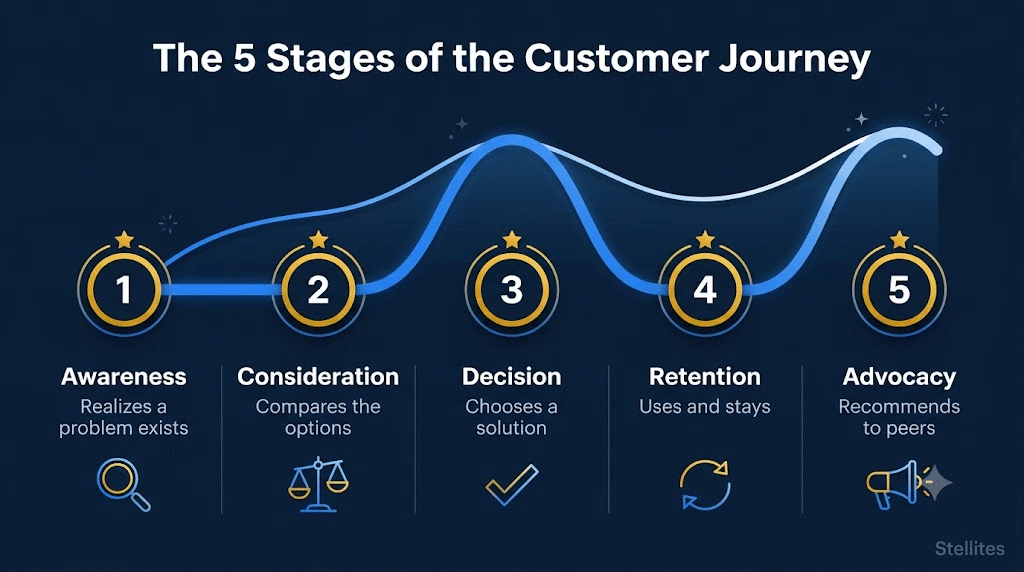
Content aimed at the wrong stage lands flat. A pricing page shown to someone still in Awareness feels pushy, while a beginner blog bores someone ready to buy today.
Not every map answers the same question, so match the type to your goal.
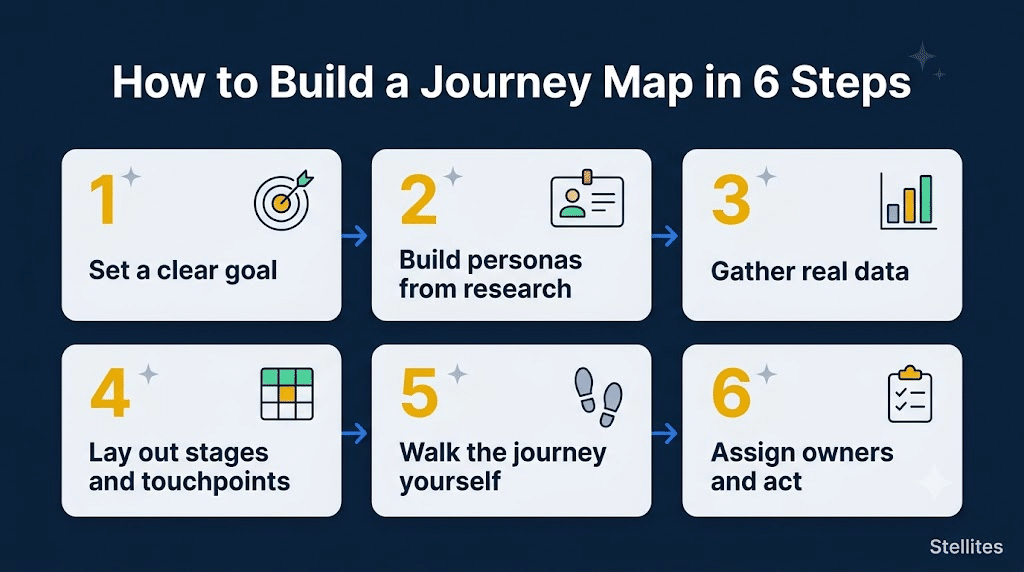
You can sketch a rough version in an afternoon and sharpen it over the following weeks. This sequence keeps the work honest.
One caution for B2B teams. You are rarely selling to one person, so give each member of the buying committee their own lane on the map.
The IT lead and the CFO travel very different roads toward the same yes. Tools like Miro, Smaply, and UXPressia make this easier, though a whiteboard handles a first pass just fine.
A few habits quietly turn a good map into wasted effort.
A customer journey map earns its keep only when it drives real decisions. Built properly, it tells your team where to spend, what to say, and when to say it.
Treat it as a living document instead of a one-time project. Update it, argue over it, and let it shape the next campaign you run.
If building and acting on that map sounds like more than your team can handle right now, that is where outside help pays off. Steel Arts is offering these digital marketing services, from journey mapping to the content and campaigns that make each stage work.