The question most businesses get wrong: you have a fixed budget. Two massive platforms want it. And every article you read either tells you to try both or gives you a generic comparison chart that does not help you make a real decision.
Here is the honest truth: the platform you choose matters less than understanding why each platform exists.
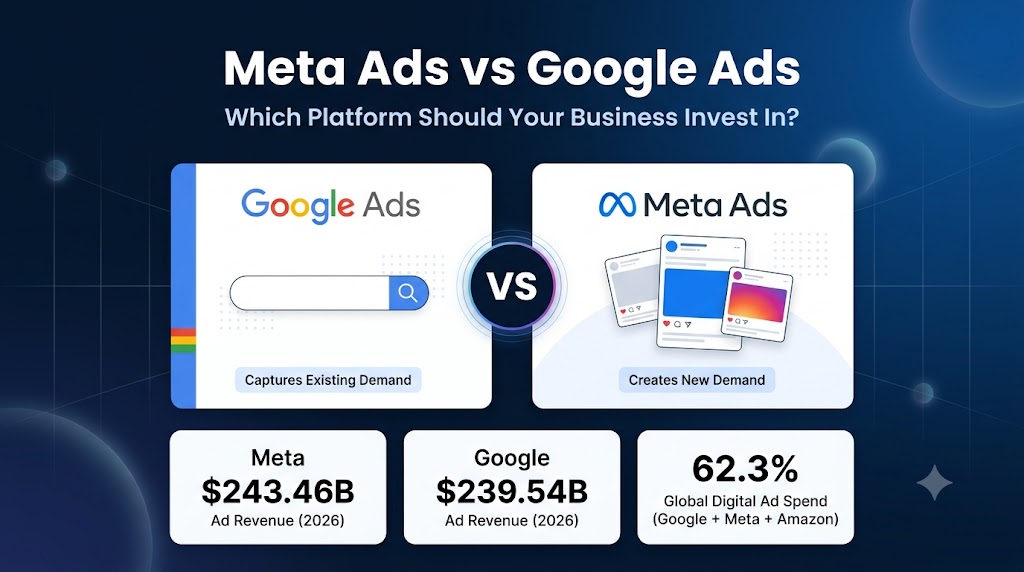
In 2026, Meta is expected to generate $243.46 billion in global ad revenue, surpassing Google’s projected $239.54 billion for the first time ever.
Together with Amazon, these three platforms now account for 62.3% of global digital ad spend.
But those numbers are not the real story. These two platforms are built on completely different mechanics. If you pick based on CPC alone, you will almost certainly pick wrong.
The right question is: where are your buyers right now, and what do they need to see before they act?
Think of it this way.
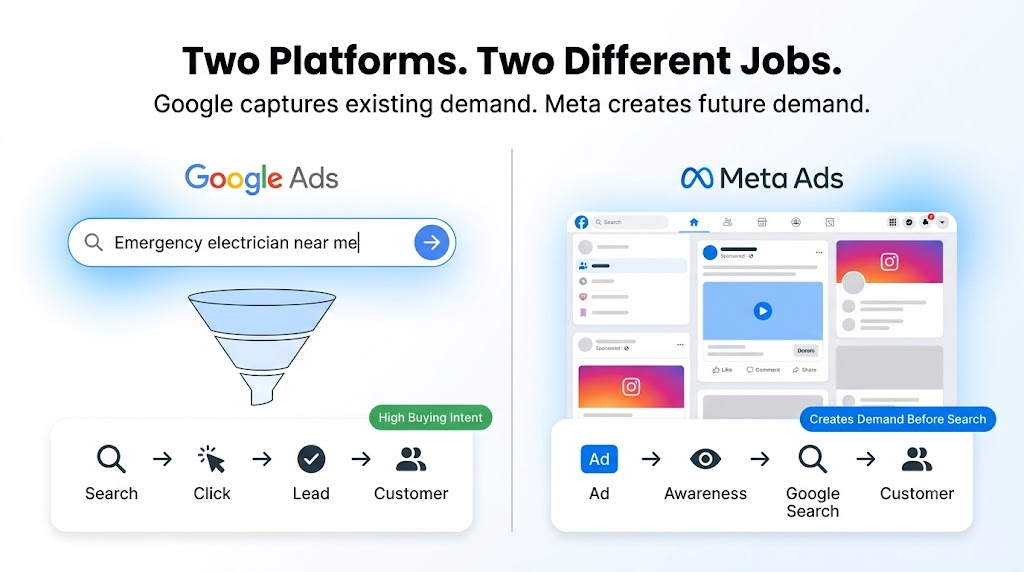
When someone searches “emergency electrician near me” or “accounting software for small teams,” they already know they have a problem. They are in buying mode. Google puts you directly in front of that intent.
Meta works from the opposite angle. Nobody opens Instagram to find a new accounting tool.
But Meta can show your ad to someone who matches the behavioral profile of a buyer, even before they know they need you. That person then Googles you three days later and converts.
That is not a flaw in Meta. It is exactly how the platform is designed to work.
Everything else flows from this one difference.
Before making any budget decision, you need current data. Here is what the numbers actually look like right now.
Based on WordStream and LocaliQ analysis of 13,000+ campaigns:
| Metric | 2026 Average |
| Average CPC | $5.42 |
| Average CTR | 6.64% |
| Average Conversion Rate | 8.18% |
| Average Cost Per Lead | $66.69 |
Legal and B2B Tech verticals can see CPCs well above $8.58. Arts and Entertainment stays as low as $1.63. These are not bad numbers as long as you know your customer lifetime value.
One positive shift in 2026: cost per lead dropped for the first time in five years, and conversion rate improved across 87% of industries.
Based on Triple Whale and WebFX Meta Marketing Benchmarks 2026:
| Metric | 2026 Average |
| Average CPC (Traffic Campaigns) | $0.70 |
| Average CPC (Lead Gen Campaigns) | $1.92 |
| Median CPM | $13.48 |
| Median CTR | 2.19% |
| Median Conversion Rate (Ecommerce) | 1.57% |
| Average CPL (Lead Gen) | $27.66 |
| Median ROAS | 1.93x |
One thing to plan for: every single industry saw Meta CPMs increase by 20%+ year over year.
That does not mean Meta is losing its edge. It means your creative has to work harder. On a tighter budget, Instagram Reels placements offer a 26% lower CPC than Facebook Feed at roughly $1.28 per click.
Looking at those numbers, Meta seems like the obvious choice. Lower CPC. Lower CPL. Easier entry point.
But run this math before you commit your budget.
The cheaper click produced the more expensive customer.
Google Search converts at 3.75% to 8.18%, while Meta cold traffic averages 1.57% for ecommerce.
The intent behind the click is fundamentally different, and it shows up directly in your cost per acquisition. Work backwards from your target CPA and margin first. CPC and CPM are input metrics. CPA and ROAS are the numbers that connect to real profit.
Here is where the “it depends” answer starts to actually mean something specific.
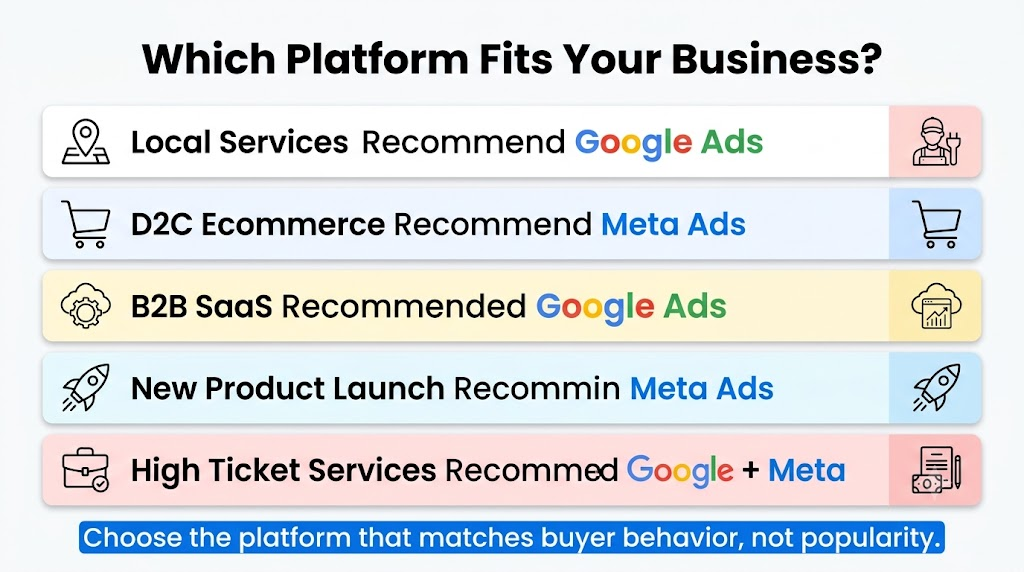
| Business Type | Start With | Why |
| Local services (clinic, plumber, law firm) | Google Ads | High-intent searches; people look when they have an urgent need |
| D2C / ecommerce (fashion, beauty, lifestyle) | Meta Ads | Visual discovery; impulse-driven buying behavior |
| B2B SaaS / enterprise software | Google Ads | Captures in-market buyers at the decision stage |
| New product with no search demand yet | Meta Ads only | You cannot capture demand that does not exist on Google yet |
| High-ticket services ($1,000+) | Google primary | Closes on intent; Meta retargets and re-engages cold pipeline |
A $27 Meta lead closing at 5% actually costs more in real terms than a $67 Google lead closing at 12%. When you track cost-per-acquisition instead of cost-per-lead, Google frequently wins in professional services, enterprise software, and high-consideration offers.
Benchmarks only mean something when they connect to actual outcomes. Here is what real campaign results look like across both platforms.
FULLBEAUTY Brands ran Meta’s Advantage+ Shopping campaigns with AI-generated creative variants in 2025 and saw a 45% jump in ROAS, a 22% rise in conversion rates, and a 36% boost in CTR. Creative quality, not audience targeting, drove the result.
A DTC apparel brand using dynamic product ads with a consistent creative refresh cycle saw ROAS climb from 2.5x to 4x. The key variable was rotating ad creatives every 7 to 10 days to prevent audience fatigue.
CodeSignal combined high-intent keyword targeting with Google’s Lead Form Extensions to reduce signup friction. The result: 284% more qualified leads with a 46% reduction in cost per lead.
The consistent pattern across all four: the platform matched the product type and funnel stage. When that alignment is right, both platforms deliver.
A lot of the 2024 paid ads guidance is already outdated. Here is what actually shifted this year.
Plan to refresh Meta creatives every 7 to 14 days. Audience fatigue moves faster than most advertisers account for in their planning.
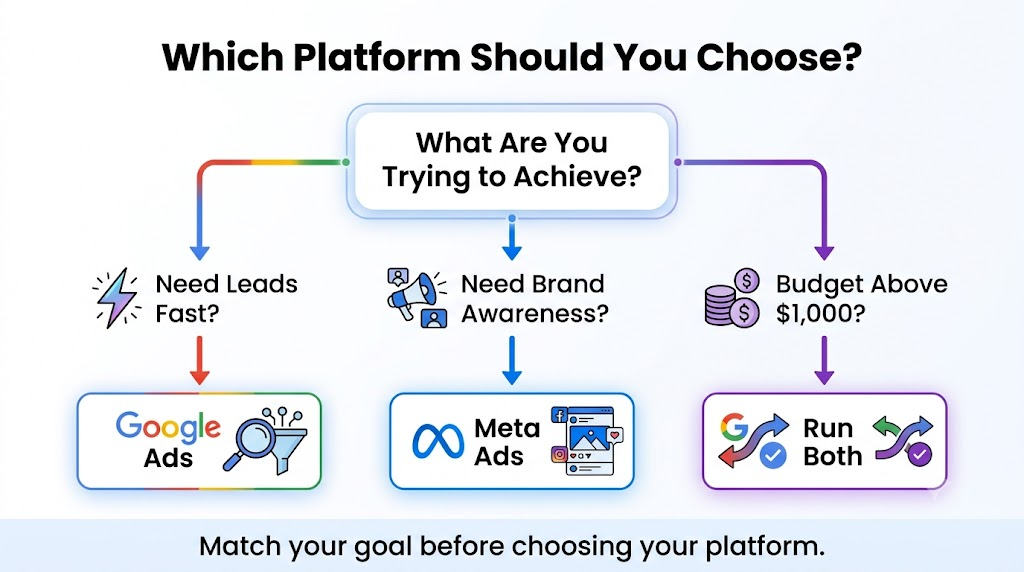
There is no universally better platform. There is only the platform that fits how your specific buyers make decisions at the budget you have right now.
Google puts you in front of buyers who are already looking. Meta builds the recognition that makes them look in the first place. The businesses that get this allocation right, and give each platform a defined role, consistently outperform those that chase cheaper clicks.
If you want help mapping this out for your business, Stellite works with brands at exactly this decision point. Get in touch and let’s figure out where your next ad budget should go.