For years, the relationship between SEO and search traffic has been straightforward. Higher rankings produced more clicks, and more clicks produced business outcomes. Agencies built their reporting around that logic, and clients expected traffic growth as proof that SEO was working. That model no longer fits how search operates now.
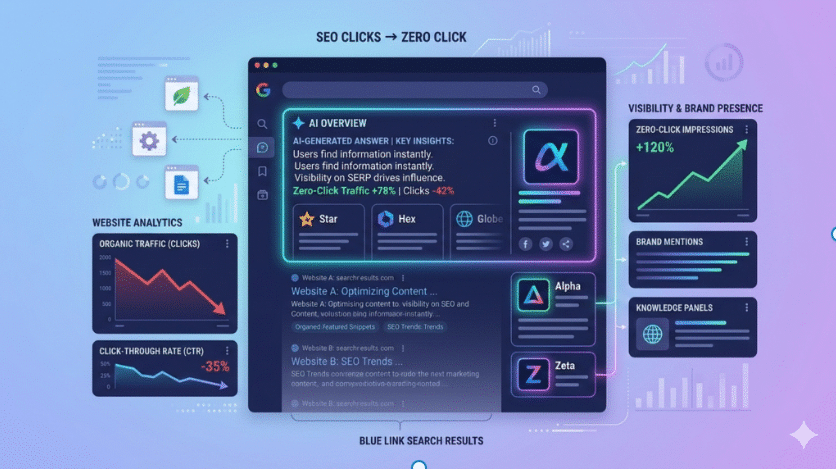
Search engines increasingly answer questions directly inside the results page. AI summaries, featured snippets, knowledge panels, and instant answers allow users to find information without opening a website. Around 58-60% of Google searches now end without a click to any external site, according to a 2025 Zero Click Study. When AI-generated summaries appear, that figure worsens. A Pew Research Center study found only about 8% of users clicked a link when an AI overview was present, compared with roughly 15% when it was not.
Rankings may improve, and impressions may rise, yet the traffic chart still slopes downward. From a client’s perspective, that decline looks like failure. From the agency’s perspective, it reflects a structural change in how search works. This blog explains how to demonstrate value when clicks no longer capture the full impact of search visibility.
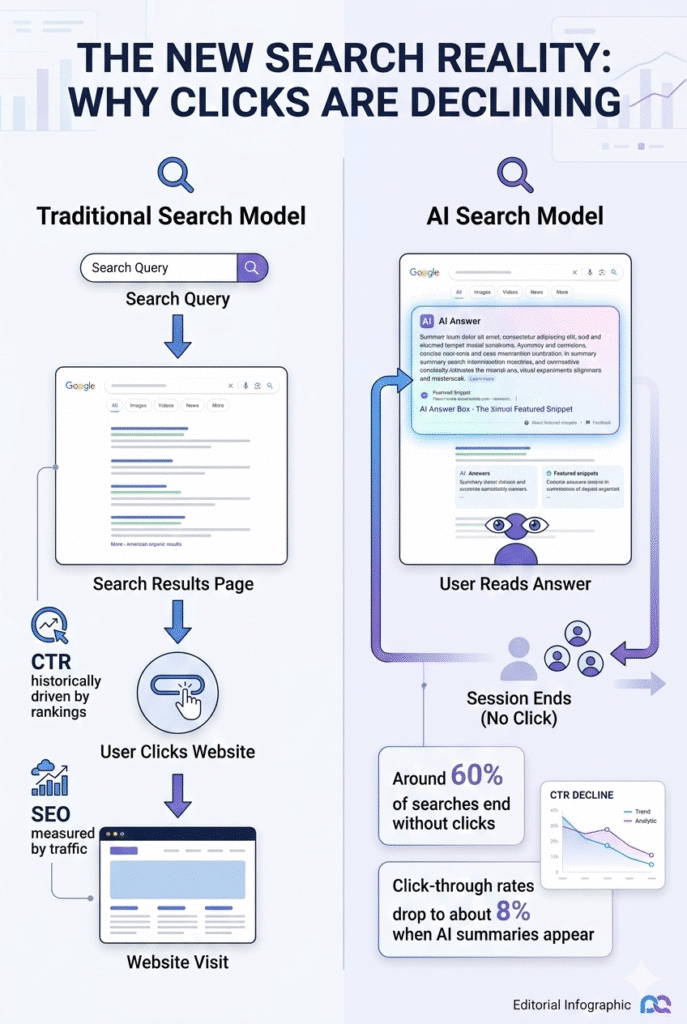
For most of the history of search marketing, SEO performance followed a simple chain: a page ranked well, users clicked, visitors converted. Agencies built reporting around that sequence: rankings → clicks → conversions.
The problem is that the structure of search results has changed. Modern results pages often answer the query before the user clicks anything. Featured snippets, knowledge panels, and AI summaries display explanations and definitions directly within the results page, eliminating the need to open another site.
This creates a reporting paradox. Rankings improve, and visibility expands, yet traffic metrics suggest decline. From a client dashboard, the campaign appears weaker, even when the brand occupies more space across the search results page than before.
The shift toward zero-click search forces a different way of thinking about what SEO actually does. A brand now appears across the results page in forms that never existed five years ago, and each placement reaches the user before they visit any site. Each placement exposes the brand during the research stage of a query, and that exposure still shapes perception. When a name repeatedly appears alongside answers to common questions, it gains credibility, and users begin to associate that brand with expertise in the topic.
The results page, therefore, acts as a discovery layer. A user may read an answer, recognize a brand mentioned within it, and return later through a direct or branded search. The visit occurs eventually, but the influence began earlier on the search results page itself. This is why visibility and traffic, while related, are no longer the same measurement.

When clicks stop reflecting the full impact of search, agencies need a different way to measure performance. The focus shifts from traffic volume to search influences and how often a brand appears when buyers are actively researching a topic. Here’s how agencies can measure zero-click SEO ROI:
Agencies that report across all five stop defending a traffic number and start showing where the buying decision actually began.
Winning in a zero-click environment requires a different optimization mindset. The goal shifts from earning a visit to appearing wherever the answer appears. Here are some practical strategies to apply:
AI search is not a temporary adjustment. It reflects how search engines now interpret and deliver information, and that direction will only deepen. Agencies that continue optimizing purely for clicks will find their strategies increasingly misaligned with how results pages actually work.
Content architecture comes first. Pages need to answer specific questions directly, not bury the answer three paragraphs in. Search engines pull from content that is precise, well-attributed, and structured around how users actually phrase queries. Vague, broad content gets passed over.
Authority signals matter more, not less. As AI systems decide which sources to cite, they favor brands with consistent topical depth, clear authorship, and a track record of appearing across related queries. A site that covers one subject thoroughly will outperform a site that covers many subjects shallowly.
Distribution strategy also needs to widen. When a brand appears only on its own site, its citation surface is narrow. Expanding that surface means showing up in more places AI systems actually pull from:
The agencies that retain client confidence are those building for influence at every stage of the search journey, not just the click at the end.
The agencies that will hold client relationships through this shift are not the ones with better dashboards. They are the ones who changed what the dashboard measures. Search still shapes what buyers read, what they remember, and what they eventually search for by name.
Agencies have been measuring the most countable part of search, not the most valuable part. Those two things were never the same. If your agency needs the expertise to close that gap, Stellites works as a white-label SEO partner, handling execution under your brand so you can show clients exactly where search is driving value.
No, search still drives awareness and influences purchasing decisions. Brands that appear consistently in results build credibility even without clicks, which often leads to direct searches and conversions later.
Informational and research-heavy sectors such as finance, health, legal, and education tend to see the highest zero-click rates, as search engines readily surface direct answers for common questions in these fields.
Not entirely. Rankings still matter as a foundational signal, but they shouldn’t dominate reporting. They’re most useful when paired with share of voice, branded search trends, and visibility metrics for a fuller context.
Yes, AI citations favor topical depth over domain size. A focused site that thoroughly covers a niche subject can outperform larger competitors by becoming the most comprehensive reference for specific queries.
It typically lags by weeks or months. Visibility accumulates gradually, so branded search lifts are a longer-term signal, best tracked quarterly rather than month-to-month to identify meaningful trends.