A new tab appeared in every Search Console account over the summer. It carries a large impressions figure, and that figure is easy to misread.
Below is what the report measures, what it withholds, and the language to use when a client points at the chart.
Short answer: Google’s generative AI performance report shows how often your pages appeared inside AI Overviews, AI Mode, and generative AI features in Discover. It reports impressions only, split by page, country, device, and date.
Google added a note to its June announcement confirming worldwide rollout on that date. No account is waiting on access anymore.
So a client has likely opened the tab already. Many will read the impressions figure as traffic, because nothing on screen suggests otherwise.
The number records presence, not outcome. Closing that gap on a reporting call, without sounding like you are managing expectations, is the real task.
Open Search Console, select Performance, then choose Generative AI in the left navigation.
Handle one objection before it lands. The report is a breakout, not an addition. Google confirms the same data stays inside the overall performance report, so your totals did not move.
Two mechanics from Google’s documentation change how you read the chart:
Apply a URL filter and the chart switches to aggregating by that URL instead. Useful when you are auditing one page in isolation.
The launch date explains more about this report than the feature list does.
Google announced the reports on June 3. The UK Competition and Markets Authority imposed its first binding conduct requirement on Google Search the same day, under the Digital Markets, Competition and Consumers Act 2024.
That requirement obliges Google to supply publishers with impressions, click-through figures and click-through rate, separated from general search data.
Two conclusions follow. The report is partial compliance rather than generosity, and reporting will improve because a regulator set deadlines.
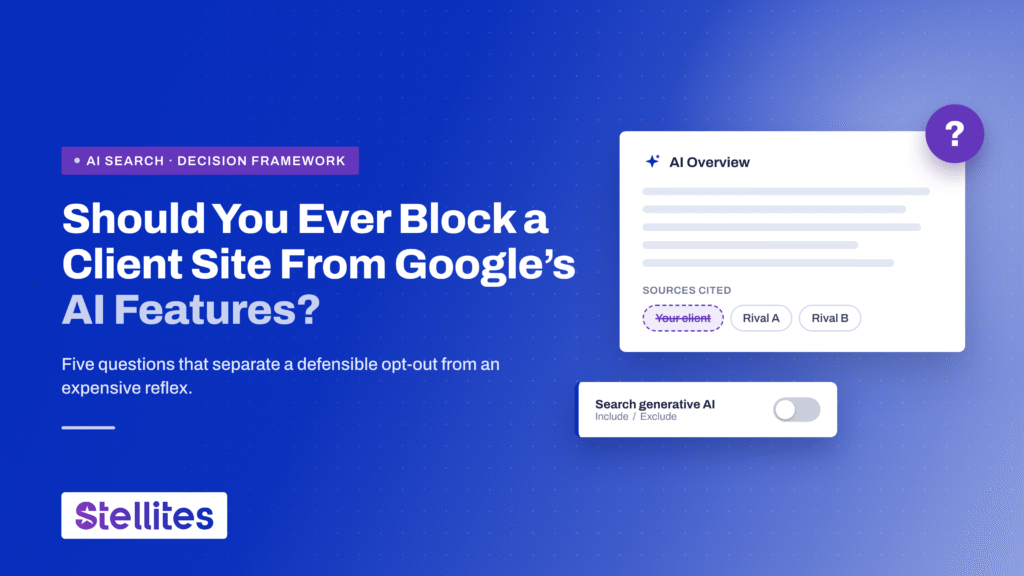
Google also launched an AI opt-out toggle that day. Three points to give any client asking about blocking AI features:
You get page, country, device, and date. Their usefulness varies sharply.
This dimension earns its place. It names the URLs Google treats as citable source material on a given topic.
Until now, AI visibility came from third-party trackers and manual prompt testing. Both sample the results page. This counts your own pages directly.
Relevant when a client sells across markets, since AI feature coverage differs by region. A weak month in one country often traces back here rather than to rankings.
Device splits carry little signal today, so record them and move on. Date lets you line up impression movements against publishing and refresh work.
The report confirms Google read the page. It cannot confirm anyone arrived.
That distinction costs more than it did two years ago. Ahrefs studied 300,000 keywords and measured a 58% lower click-through rate for the top-ranking page when an AI Overview appears, against 34.5% in its April 2025 run.
Practical effect: no funnel modeling from this data. Treat AI impressions like a brand mention in a trade title, worth pursuing and hard to attribute.
No clicks means no rate, so comparing AI visibility against organic efficiency stays off the table.
Pew Research tracked 68,879 searches across 900 US adults. Participants clicked a standard result in 8% of searches carrying an AI summary, against 15% of searches without one.
Cited links inside the summary fared worse, drawing clicks in roughly 1% of visits. Hold that figure in mind before presenting impressions as a result.
You cannot see the prompt or query behind an appearance. Page level is the floor.
Practical effect: intent analysis and content-gap work stay manual. Keep running prompt tests, because this report replaces none of that.
Dismissing the report outright is the wrong correction.
Seer Interactive examined 3,119 informational queries across 42 organizations. Brands cited inside AI Overviews earned 35% more organic clicks than brands left out of the same answers.
Seer’s study lead, Tracy McDonald, flagged the limit on that finding. Citation may not cause the lift, since stronger brands plausibly attract more citations to begin with.
Raise that caveat yourself during the call. Naming the weakness in your strongest number is what makes the rest of the deck believable.
Language that holds up under questioning:
“This confirms Google’s answer layer is reading and using our content. That is what the last two quarters of work targeted, and we can now see it directly.
It does not tell us whether those appearances produced visits or revenue. Branded search, direct traffic and conversions still carry that part of the story.”
Three rules worth keeping:
The page data works now, so build something from it before the feature matures.
That gives you a scoped deliverable for the current month, independent of Google’s roadmap.
One warning on step five. Structural changes take weeks to register, and AI feature coverage shifts constantly, so treat a flat result at 60 days as inconclusive rather than proof the approach failed.
The dates are published, so plan against them rather than speculate:
Click-through reporting sits inside that order as an obligation, not a rumor. Two questions stay open, namely when Google ships it and whether accounts outside the UK receive the same data.
What does the generative AI report in Search Console show?
It records impressions for pages surfaced in AI Overviews, AI Mode, and generative AI features in Discover. You can segment that data by page, country, device, and date range.
Does the Search Console AI report include click data?
No. The report covers impressions only, with no clicks, click-through rate or average position. Clicks earned through AI features stay inside your overall Search performance totals instead.
Did my Search Console traffic numbers change when this report launched?
No. Google separated existing data into a dedicated view rather than adding anything new. Your overall performance report continues tracking the same impressions it tracked before June.
Can I see which queries triggered an AI Overview appearance?
No. Query and prompt data sit outside this report entirely. Page level remains the most granular view available, so intent analysis still depends on manual prompt testing and third-party trackers.
Should a client opt out of Google’s AI features?
Rarely. Opting out removes impressions and any traffic those features generate, and the control currently applies to an entire domain. Page-level choice arrives in March 2027.
Error: Contact form not found.
Enter your email to receive your exclusive coupon and start saving on your next purchase. Don’t miss out on special deals and updates!
Error: Contact form not found.