The short answer: When a client asks why they still pay full retainer now that you use AI, the right answer depends on which question they are really asking. A price test needs a calm value reframe. Genuine confusion needs a plain breakdown of what the fee buys beyond production. A client who plans to bring the work in-house needs a conversation about risk and continuity, not price.
It usually comes up near renewal, sometimes as a throwaway line at the end of a call. “You’re using AI on most of this now, right? So why hasn’t the retainer changed?”
If you’ve had this conversation once and walked away feeling you fumbled it, you’re in good company. In Productive’s survey of 180+ agencies, roughly a third had already been asked for an AI discount, and nearly half expected the question soon. Only 13% of agencies had actually lowered their prices.
And it lands on owners who are already uneasy: SparkToro’s 2025 State of Digital Agencies survey found 53% now see AI as a significant threat to the agency model, up from 44% a year earlier.
Holding your price and winning the conversation are two different things, though. Most agencies that lose this one lose it for the same reason. They treat it as one question when it’s actually three.
Start here, because it changes your tone. If AI made parts of the work faster and the invoice stayed the same, someone kept the difference. Asking where it went is a normal commercial question.
Your client has also watched ChatGPT draft a blog post in under a minute. And parts of their logic hold up:
Where the logic breaks is the assumption that the retainer was buying hours of production in the first place. Hold on to that thought. Everything below comes back to it.
Agency owners tend to reach for one of three replies. Each sounds fine until the client asks a single follow-up.
This contradicts your own website and probably your last proposal. If the client believes you, the next thought is “so you’re behind.” If they don’t, you’ve lost their trust.
Often partly true. But the client still gets the same four articles and the same monthly report. The follow-up writes itself: “Great, can you show me what the extra time produced last quarter?” Without a record of it, you have nothing to show.
Fair in principle, and it falls over the moment the client pulls up your original proposal with “40 hours per month” printed on it. You told them they were buying hours. Now they’re holding you to it.
Then there’s the fourth reflex: knocking 10% off on the spot. It tells the client the fee had padding in it, and it becomes the new floor.
“Why are we still paying full retainer?” can mean any of these:
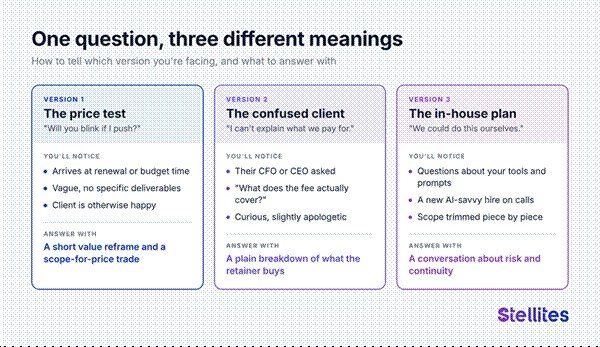
It’s probably a price test if:
It’s probably confusion if:
It’s probably an in-house plan if:
If the signals are mixed, ask: “If AI frees up time on your account, would you rather see a lower fee or more work for the same fee?” A quick “lower fee” points to a price test. “What would more look like?” points to confusion. “Neither, we want to own more of this” tells you where you stand.
Keep it short. A long, anxious answer tells the client there’s room to push. Four moves, under a minute:
The trap is defending the fee with hours. The second you say “it still takes us about 40 hours,” you’ve agreed the fee is for hours, and every future AI improvement belongs to the client.
This client usually wants to stay. They just need something to repeat upstairs, and a simple breakdown usually does it.
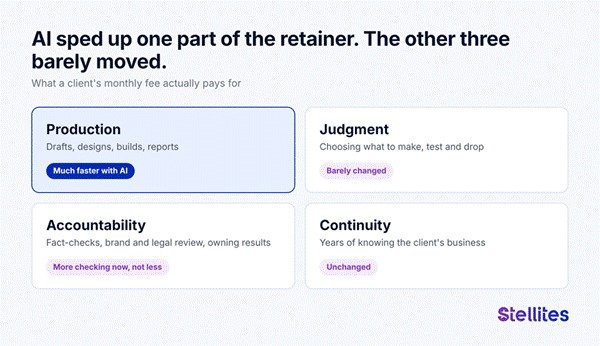
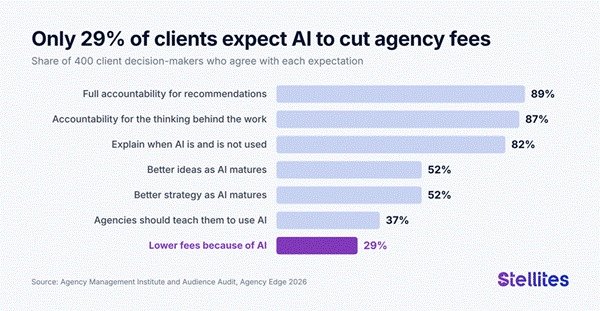
Clients care about the last three more than agencies assume. In the Agency Edge 2026 study of 400 client decision-makers, 89% expect full accountability for recommendations even when AI is involved. Only 29% expect AI to reduce agency fees.
Say production makes up about 40% of the fee and AI cut that effort by 40%. The fair adjustment is roughly 16% of the retainer, not 40%. Then weigh that against new review work and tool costs. Real savings are modest anyway. The State of PPC Global Report 2026, based on 1,306 respondents, found AI saves practitioners about five hours a week on average.
Put the breakdown on one page, using their account, and offer to send it to their CFO. It’s easier if your delivery already runs on a small senior team. We’ve written about how senior-led pods are replacing the agency pyramid.
They’re comparing your fee to a salary. You will lose a price argument against a salary every time. The trend is real, too. In the State of PPC Global Report 2026, 20% of clients said they were likely to replace some agency work with AI, while only 12% planned to switch agencies.
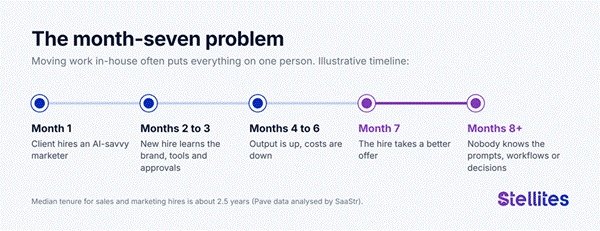
Picture it. They hire an AI-savvy marketer in month one. Months two to six go well. Then in month seven, that person gets a better offer.
In-post image 4: in “Fight It on Month Seven” · img-month-seven.png
Now nobody else knows the prompts, the workflows or why decisions were made. Pave data analysed by SaaStr puts median tenure for sales and marketing hires at about 2.5 years, the shortest of any department. Gallup estimates replacing an employee costs half to twice their annual salary. Agencies know this from their own side, which is why long-term employee retention matters so much.
So ask, calmly: “What happens if the person who owns this leaves? Who holds the knowledge then?”
Managed talent, where the provider handles hiring and replacements, exists for this exact risk. Here’s why managed employees often beat dedicated hires. If the client leaves anyway, hand over properly. A clean exit is your best shot at the call that comes in month eight.
If you bill hourly, or your retainer is an hours estimate in a monthly costume, this conversation will come back every time a new AI model ships. One PPC consultant quoted in the State of PPC report put it bluntly: billing by the hour means taking a pay cut every time you get better at the job. Even WPP now earns 20% to 25% of its net sales from performance-linked fees.
The alternatives aren’t exotic:
Price on scope and results, and AI efficiency becomes your margin instead of the client’s refund. Leaner delivery costs help too, and managed talent can cut agency overheads without hiring risk.
Sometimes they are. If your contract is hourly, if pass-through costs fell but your rate didn’t, or if you charge premium rates for basic social posts, they have a point. Say it first:
Price the commodity work down and protect the judgment work. The agency that admits the fair part is the one whose other claims get believed.
Which version do you hear most: the price test, the confused client or the in-house plan? And what did you say? Tell us in the comments. We’re collecting the best answers for a follow-up.
Work out what they’re really asking. A price test needs a short value reframe. Confusion needs a breakdown of what the fee buys. An in-house plan needs a talk about risk, not price.
Only where AI made specific work cheaper, or where the contract is hourly. Reprice those items openly and avoid blanket cuts.
Show the four things it pays for: production, judgment, accountability and continuity. Admit AI changed production, and show where the saved time went.
Don’t argue price. Ask what happens if the person who owns the work leaves, then offer strategy, training or backup cover.