Most agencies that cut their junior layer this year expected the work to move to AI. A lot of it did. Some of it moved up to the most expensive people in the building.
And some of it just stopped. Nobody noticed for a quarter or two.
That third bucket is the part of agency operations nobody budgets for. It’s also why two agencies can adopt the same structure and end up in very different places a year later.
What is a senior-led pod? Three to six experienced people who own a set of clients end to end. AI handles repeatable research, checks and reporting. People own strategy, judgment and the client relationship.
Below: how the pod works, what it costs, and where it breaks.
The old agency pyramid wasn’t a talent philosophy. It was arithmetic. A junior hour cost less than it billed, and one senior could check four or five juniors faster than doing the work alone.
It also did a second job that never showed up on a P&L. It trained people. Juniors learned judgment by pulling reports and writing drafts that came back covered in red.
AI broke the first job in three specific ways:
What AI didn’t do is make its own output trustworthy. Somebody still has to check it.
So the review layer, which is what clients were really paying senior rates for, got more important just as its foundation disappeared.
The market numbers line up. Worldwide ad spend grew 8.6% in 2025 while holding company revenues fell 1.2%, per EMARKETER.
Forrester projects a 15% cut to agency jobs in 2026, after about 8% in 2025.
That’s a forecast. Still, in a Sunup survey of 225 US agency executives, 91% said they expect AI to reduce headcount as value shifts to senior-led work.
One caveat. The pyramid was cracking long before ChatGPT. Zoe Scaman argues that many agencies had already turned juniors from apprentices into cheap executors. AI just gave that habit a respectable excuse.
Agencies have run pods for about a decade. The 2018 version was a small account team with juniors doing most of the hands-on work. It fixed silos. It didn’t change who did the execution.
The senior led pod changes three things:
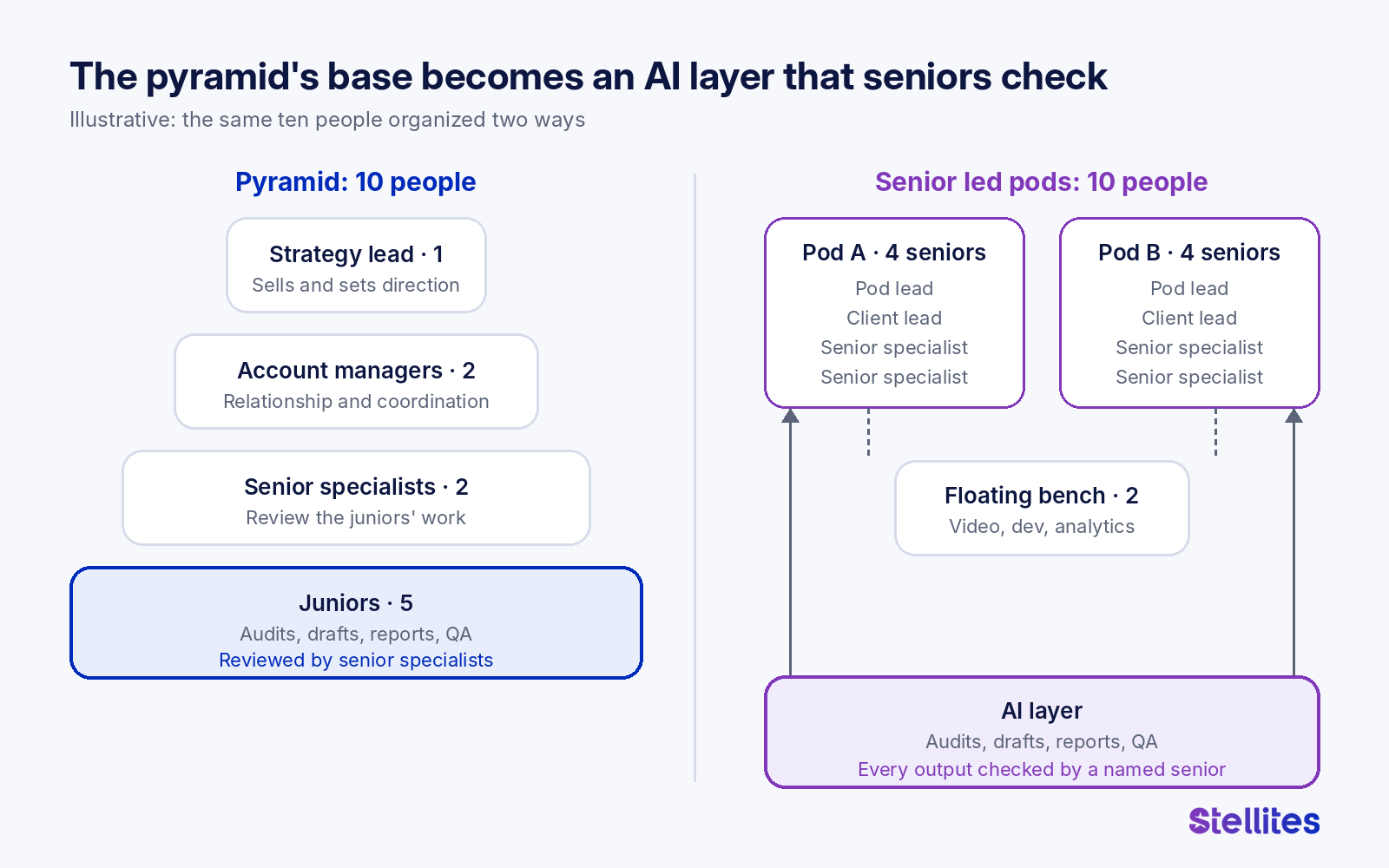
Same ten people, two structures. The execution work sits in the same place; what changes is who does it and who signs it off.
For a content and performance agency, a four or five person pod usually includes:
In smaller agencies the pod lead and client lead are one person. A pod like this typically carries five to ten clients.
Most pod diagrams leave out one thing. A pod’s capacity is set by how much its seniors can check, not by how much its AI can produce. Once seniors start skimming, the pod is overloaded.
Vaibhav Kakkar of Digital Web Solutions said it well on a Forbes Agency Council panel: “We are moving from a staffing ladder to a judgment network.”
The org chart stops showing who manages whom. It shows who signs off on what.
Most pod articles stop at “fewer people, more output.” We ran the numbers on a ten-client SEO and content practice. It’s messier than that.
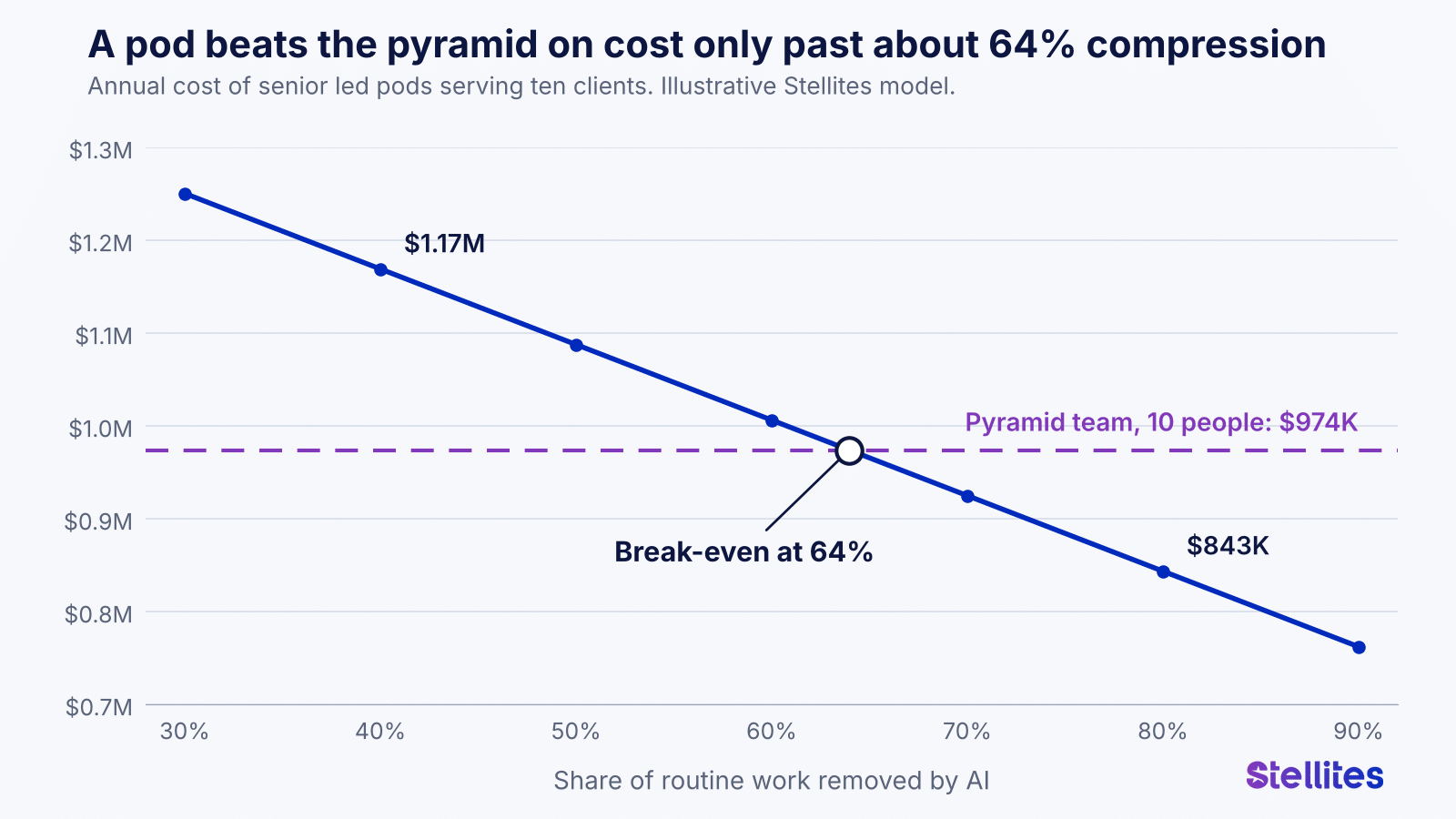
Illustrative Stellites model. The pod beats the pyramid on cost only once AI removes about two thirds of the routine work.
The pod only gets cheaper than the pyramid once AI removes about 64% of the routine work. At 40%, it runs roughly $1.17 million a year. At 80%, about $843,000.
Output per person climbs either way, from 1.0 to about 1.7 clients per head. But each senior costs roughly 50% more than the pyramid’s average head.
Review time decides more than people expect. Double it to 20% of routine hours and the break-even jumps to around 74%. Your numbers will differ, so run them before you restructure.
When the base of the pyramid goes, its work ends up in one of three places. Most restructuring plans only account for two.
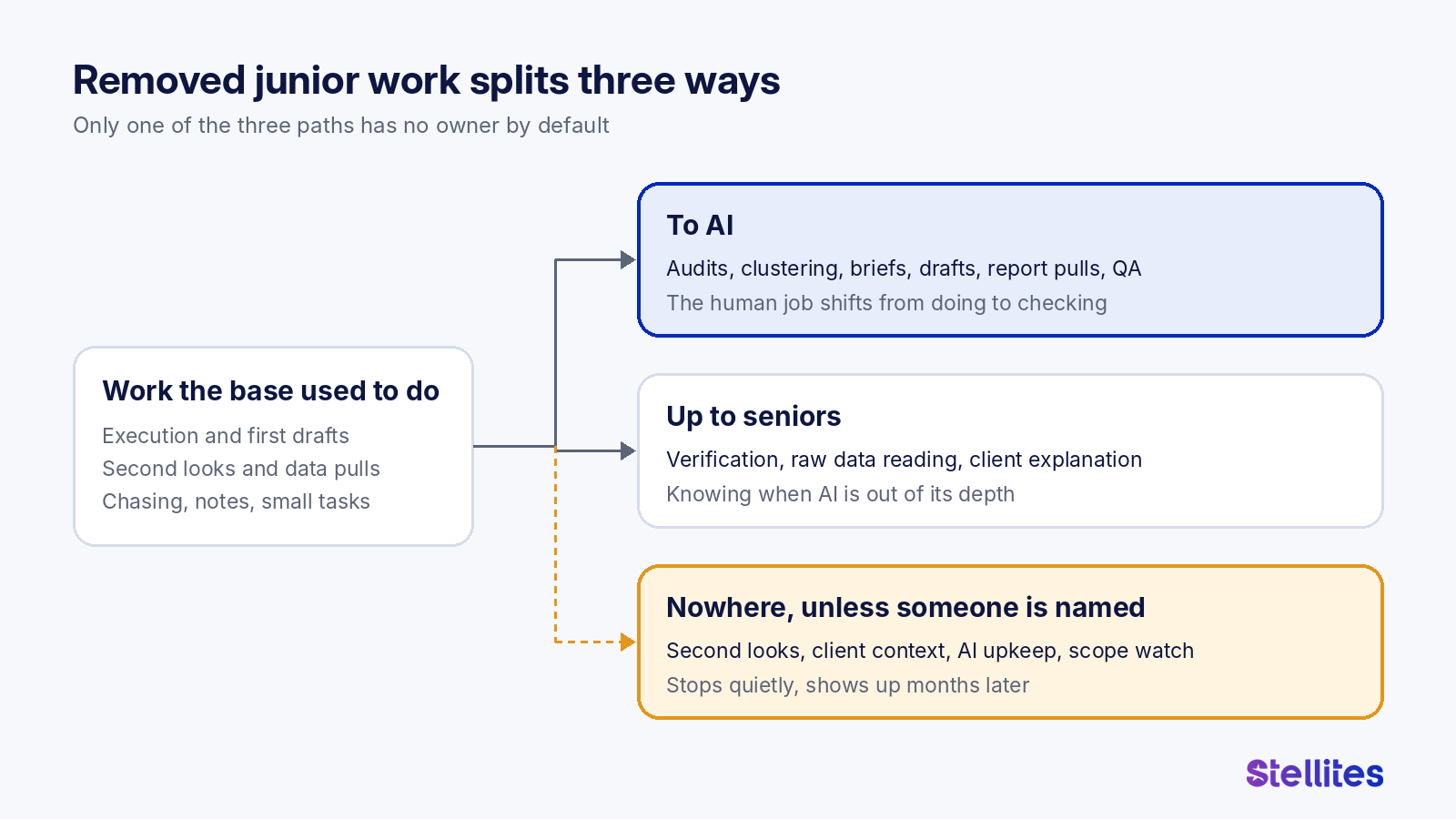
Removed junior work splits three ways. The third path only gets an owner if someone assigns one.
Audits, keyword clustering, briefs, first drafts, report pulls and QA checklists. SEOJuice reports a 2,500 word draft dropping from four hours to 90 minutes, editing included.
“Moved to AI” doesn’t mean nobody touches it. The human job changes from doing the work to checking it.
Verification. Reading raw data before the AI summary. Working out what you can actually tell a client when the numbers are messy. And knowing when AI is out of its depth.
That last one matters. In a Harvard Business School and BCG study of 758 consultants, those leaning on AI outside its abilities were 19 points less accurate (summary on Forbes).
This is where pods fail. The pyramid did plenty of work that never sat in a job description, because juniors soaked it up. Remove them and some of it doesn’t move. It stops.
The five we see most often:
Before you remove a layer, list everything it did that never made it into a job description. Then give each item an owner, a tool, or a conscious decision to stop.
Some skills matter but aren’t weekly: video, information architecture, technical migrations, analytics setup. Put one in every pod and you pay for idle hours. Put none anywhere and you scramble every launch.
A simple test: if fewer than half of a pod’s clients need a skill in a typical month, it floats. There are four common ways to run that bench:
Either way, name one requester per pod. Without that, Karl Sakas warns, some pods always grab the “best” shared people.
A badly set up pod produces worse work than a well run traditional team. We’d rather say that plainly.
In a randomized trial by METR, experienced developers were 19% slower with AI on complex codebases, while believing they were 20% faster. Slow and confident is worse than slow. Nobody goes looking for the problem.
The patterns we run into most:
Unmanaged usage gets expensive fast, which is why we covered how teams waste Claude tokens in a separate post.
A senior led pod has five recurring handoffs:
Each needs four things: a named owner (a person, not a role), acceptance criteria, a record of what the AI was asked and what changed, and a fixed slot for the check.
Seer Interactive makes AI show its SQL and math before any result goes out, as MeasureU describes. Any handoff missing one of the four is where your next client complaint starts.
The structure is the easy part. The handoffs are the job.
According to the 4As, 57% of agencies have slowed or paused entry-level hiring. At a Digiday town hall in September, one owner said they’d stopped hiring graduates for good.
Stanford researchers found a 13% relative drop in employment for 22 to 25 year olds in the most AI-exposed jobs. Older workers in those roles held steady.
Every senior strategist was once a junior. So where does the next generation come from? There are partial answers:
None of these is complete, for a structural reason. A pod beats the pyramid only when seniors are close to fully booked. Teaching needs the opposite: spare senior time and routine work to practice on.
In our model, the savings from removing the base (about $131,000 a year at 80% compression) roughly equal the cost of two apprentices.
Keeping a training path open isn’t an efficiency play. It’s a choice about the agency you want in five years.
We don’t have a clean answer, and we’re wary of anyone who claims one. A pod built today runs on judgment formed in the old pyramid.
Agencies that keep some kind of apprenticeship going, and get serious about keeping the people they’ve already trained, will have seniors to promote in 2032. Everyone else will be bidding for them.
Most independent agencies can’t hire a full senior pod for every client group at once. Senior people are scarce, and the math only works once your AI workflows are mature.
A few realistic paths:
That last one is what we do at Stellites.
Our dedicated SEO and digital marketing executives work under your brand and your review rules. A dedicated full stack developer can sit on your floating bench for builds and migrations.
If you’re weighing it up, we’ve written about why managed talent tends to beat plain dedicated hires and what it does to agency overheads.
What is a pod structure in an agency?
A small team that owns a set of clients end to end. In a senior led pod, three to six experienced people own strategy and clients, while AI handles routine research and reporting.
How many people should be in an agency delivery pod?
Usually three to six, carrying five to ten clients. The real limit is review capacity. If seniors are skimming AI output instead of checking it, the pod is overloaded.
Does AI replace junior agency roles?
It replaces much of their routine work, like audits and first drafts. It doesn’t replace the learning those tasks gave. Brainlabs actually grew junior hiring by training on AI from day one.
How do you structure an agency team in 2026?
Start with the work, not the org chart. Sort tasks into AI work, senior judgment and unowned work. Build small pods around client groups, share occasional skills, and name an owner for every handoff.