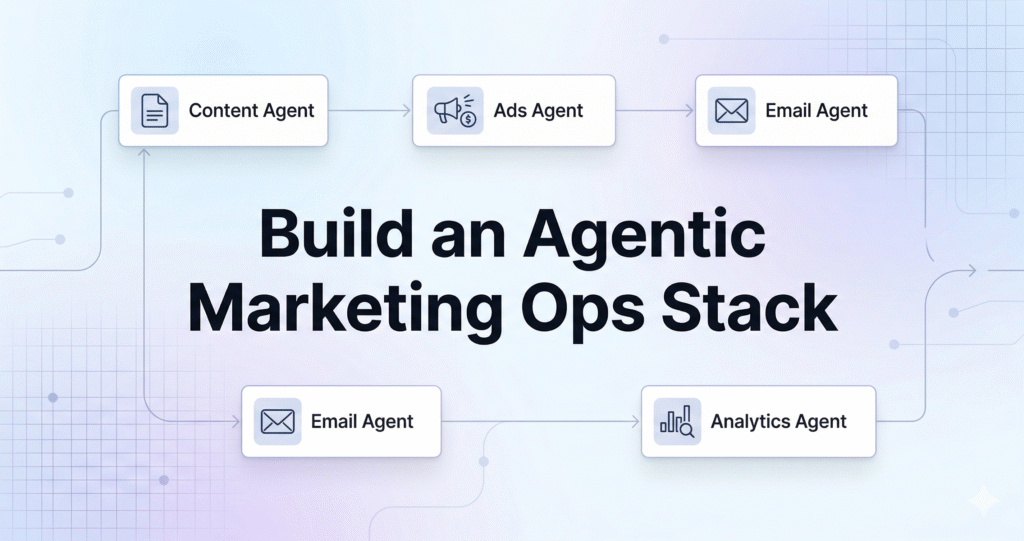
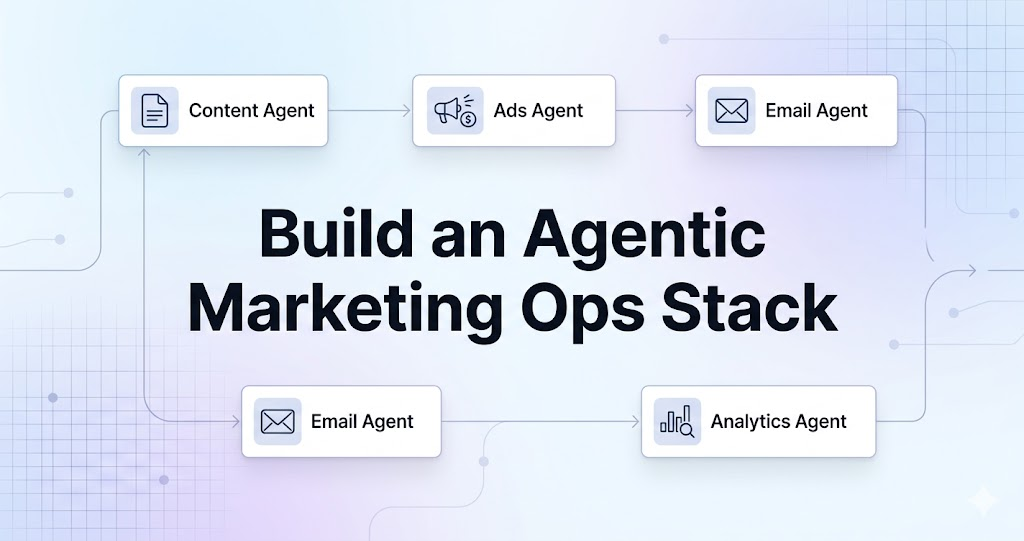
Marketing teams have added more tools than ever. Yet campaign execution still feels slow. Work moves from planning to content, then to ads, approvals, and reporting, with delays at every step.
A report by McKinsey & Company highlights the gap clearly. Nearly 45% of work activities can be automated with current technology, but most teams are not seeing that benefit in daily operations.
The issue is not capability. It is how work flows across systems and teams. Handoffs, tool switching, and repeated coordination slow everything down.
AI tools have improved output at the task level. But they have not fixed how marketing work moves end-to-end.
An agentic marketing ops stack addresses this. It connects planning, execution, and reporting into a single system where agents manage the flow, not just individual tasks.
Most teams have already added AI into their daily work. Writers use tools for drafts. Designers use separate tools for creatives. Paid teams run their own workflows. Project managers track everything in another system.
Each role is moving faster on its own. But the overall campaign is still slow.
Here’s what actually happens in most teams:
Every step works. But nothing is connected.
This creates a gap. Work moves, but not smoothly. Teams spend more time coordinating than executing.
That’s the real issue.
Marketing today is a mix of strong tools and weak flow. The system depends on manual handoffs, follow-ups, and constant alignment.
What’s missing is simple. Coordination and continuity.
Now compare that with a different approach.
An agentic marketing ops stack is not about adding more tools. It is about connecting the work.
Agentic Marketing Ops Stack = A system where multiple AI agents handle different parts of marketing, working together as a coordinated engine.
In this setup:
For example, a blog post does not stop at writing. It moves forward automatically:
All without restarting the process each time.
This is the shift. From isolated AI usage to connected marketing execution.
Before we talk about a full marketing system, it helps to see how one complete workflow is structured.
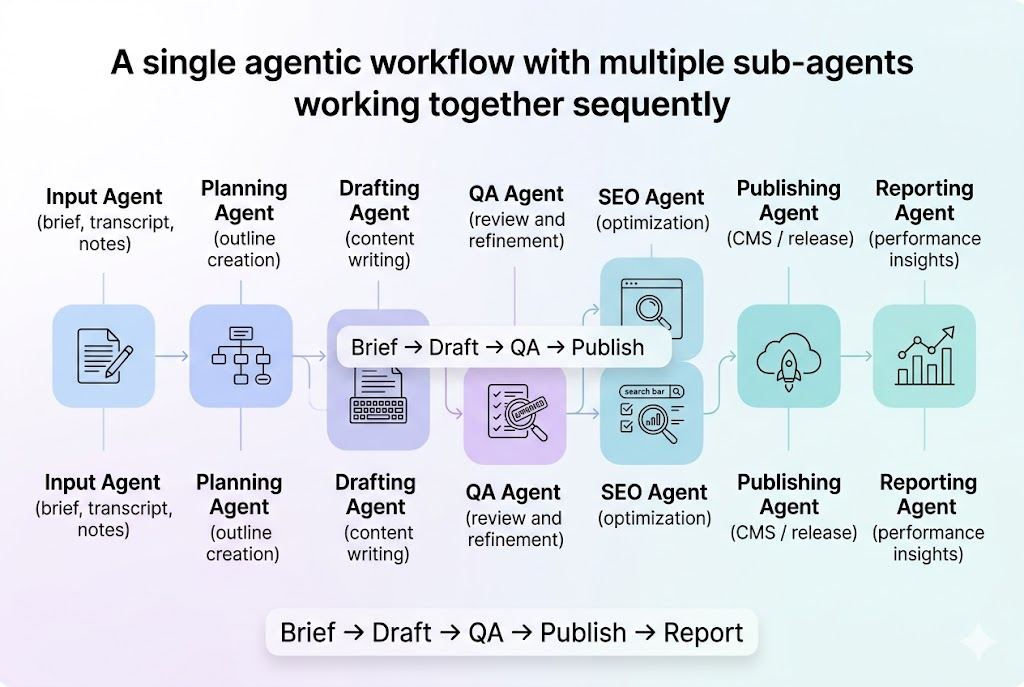
Most teams think of a “blog agent” or “content agent” as one unit. In reality, one agentic workflow is made up of multiple sub-agents, each handling a specific step.
Let’s take blog generation as an example and see how this connects end to end.
Each of these is a sub-agent working within one workflow.
This entire flow can be summarized as:
Brief → Draft → QA → Publish → Report
But behind this simple view, multiple sub-agents are working together.
This is what one agentic workflow looks like.
Now imagine multiple such workflows running together. A blog workflow, a social workflow, an ads workflow, all connected through shared inputs and feedback.
That is how a complete agentic marketing ops stack is built.
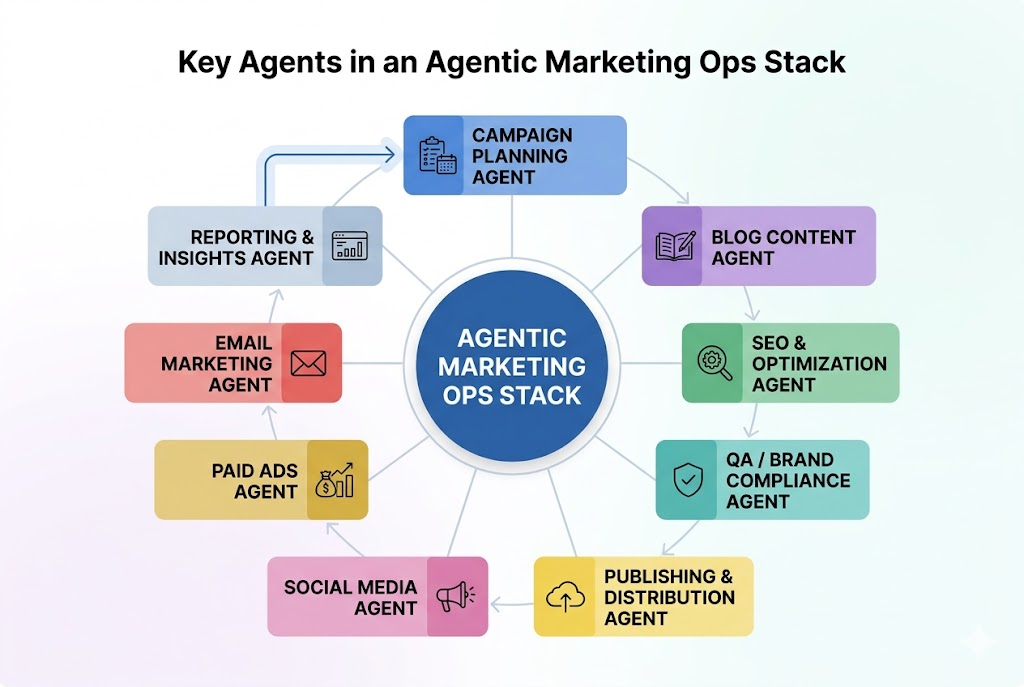
An agentic marketing setup is built as a group of focused agents, each handling a specific part of execution.
Instead of one large system, this approach breaks marketing into smaller units that work together and keep campaigns moving without constant coordination.
This agent converts raw inputs into a structured campaign plan. It takes goals, audience insights, and context, then defines direction for execution.
This becomes the base layer. Every other agent depends on this output to stay aligned.
This agent handles long-form content like blogs and landing pages. It follows a structured flow and ensures consistency from start to finish.
It works through stages such as Brief → Draft → QA → Publish → Report. Each stage may involve sub-agents working together.
Over time, it improves based on performance data, which helps maintain quality across content pieces.
This agent focuses on distribution through short-form content. It takes inputs from blog or campaign assets and adapts them for social platforms.
The goal is to maintain presence without repeating the same message.
This agent is built for testing and performance.
It creates multiple ad variations, including headlines and copy, and supports A/B testing. Based on performance, it adjusts messaging and suggests improvements. This reduces manual effort in testing and helps teams respond faster to what is working.
This agent manages email campaigns from creation to tracking.
It also feeds performance insights back into the system to improve future campaigns.
This agent focuses on improving visibility and structure.
It suggests keywords, refines content structure, and recommends updates based on performance. It may also handle internal linking and basic on-page improvements. Its role is ongoing, ensuring content stays relevant over time.
This agent acts as a control layer across all outputs.
This becomes important when multiple agents are generating content at scale.
This agent handles execution across platforms.
It formats content, schedules posts, and ensures timely publishing. It reduces manual uploads and helps maintain consistency across channels, especially when campaigns run across multiple platforms at once.
This agent closes the loop.
It collects data across campaigns, analyzes performance, and shares insights that can be used to improve future work.
These are the core agents most teams start with. As needs grow, more agents can be added for areas like video, influencer campaigns, or conversion optimization.
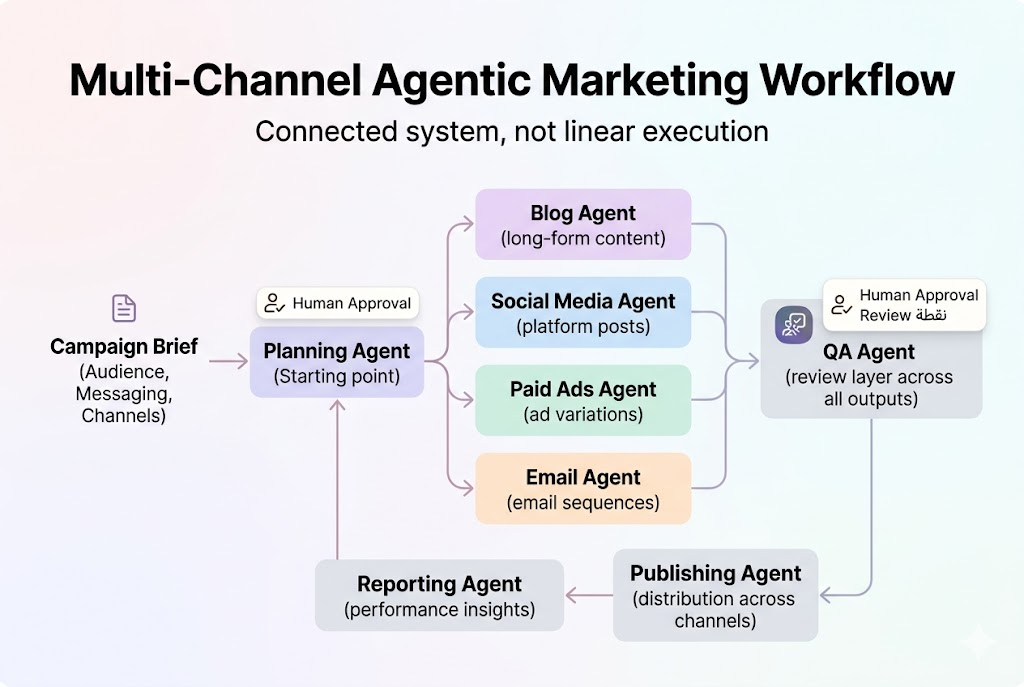
In the previous section, we looked at how a single workflow, like blog creation, is made up of multiple sub-agents working in sequence.
Now extend that idea across marketing.
Instead of one workflow, you have multiple workflows running together, connected through shared inputs and feedback, with humans stepping in where needed.
This is not a linear handoff. It is a connected system.
Each agent works on the same base input, which reduces misalignment. Human input comes in at key points like approvals, messaging changes, or strategy shifts.
With this setup, teams can automate a large part of execution while still maintaining control.
Most importantly, this is a loop. Insights from reporting feed back into planning, which improves the next campaign cycle.
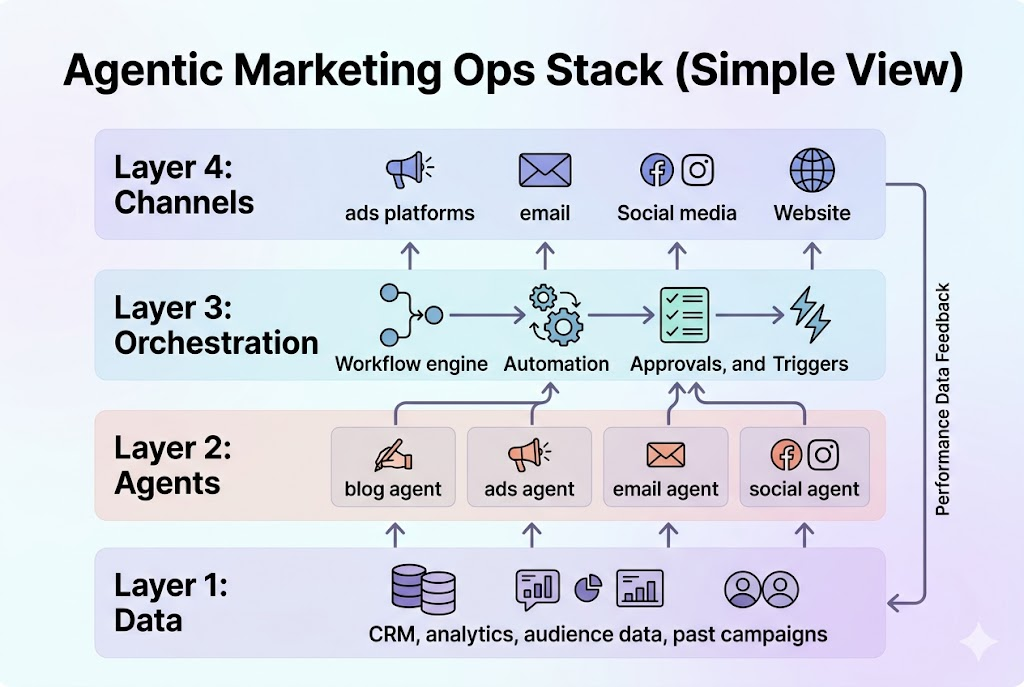
To make this system work, you need a clear structure. Not more tools, but a better way to connect them.
A simple way to look at it is through four layers.
When these layers are connected properly, marketing stops being a set of tasks and starts working as a system.
You don’t need to build everything at once. Start small and expand step by step.
Begin with one workflow that already takes time in your team. This could be blog creation, ad copy, or email campaigns. The goal is to replace a manual flow with a structured agent-driven process.
Start simple. Build one working system. Then scale it across your marketing operations.
Marketing teams don’t have a tool problem anymore. They have a workflow problem. Work is still moving in pieces, even though execution at each step has improved.
An agentic marketing ops stack fixes this by connecting how work flows, not just how it is done.
Start small. Focus on one workflow and make it run end to end without friction. Then expand by adding more agents and connecting them through shared inputs.
The goal is not full automation from day one. It is building a system that improves with each campaign.
Teams that focus on systems will move faster and stay consistent as they scale.