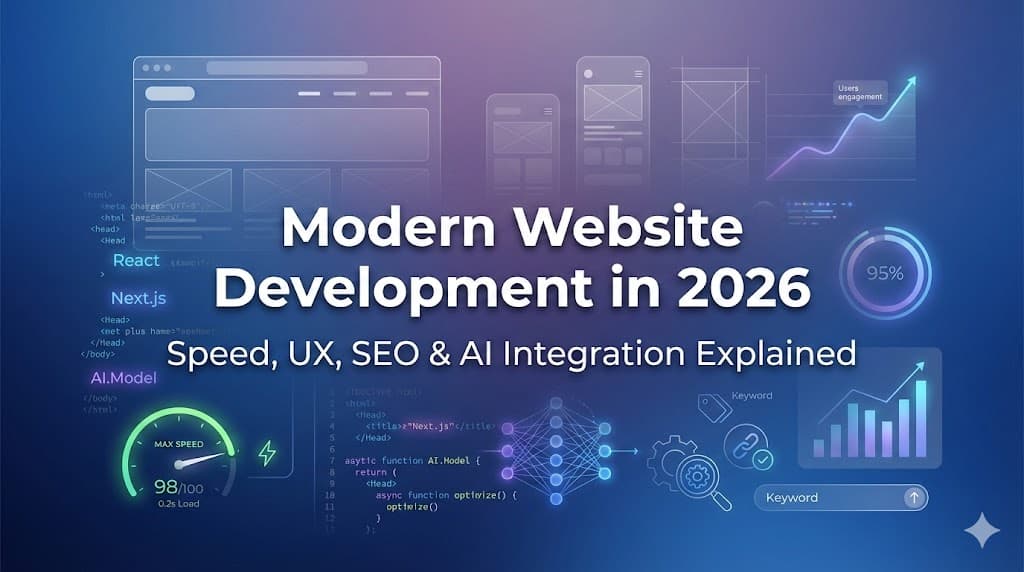
In 2026, a company’s website is more than a digital brochure. It is the first point of contact for most customers.
Nearly half of all users expect a website to load in under two seconds, and slow load times reduce conversions sharply. For business leaders, this fact means web performance directly impacts revenue, brand trust, and competitive edge.
Modern buyers make decisions quickly. A site that loads fast and feels intuitive increases engagement and repeat visits.
A business that ignores web performance loses potential clients to competitors who meet user expectations first. So, effective web development in 2026 must focus on speed, user experience, SEO, and smart integrations.
In this blog, we explain key performance metrics, UX design, headless CMS, AI features, and SEO fundamentals that matter most for strong business results.
Website speed in 2026 is directly tied to revenue performance, marketing efficiency, and brand perception.
Google research shows that when page load time increases from 1 second to 3 seconds, the probability of bounce increases by 32 percent.
For businesses running paid campaigns, even a one second delay can reduce conversion rates and waste ad budgets.
Core Web Vitals now serve as measurable indicators of real user experience. Largest Contentful Paint tracks loading performance, Interaction to Next Paint measures responsiveness, and Cumulative Layout Shift evaluates layout stability.
Search engines use these metrics to assess page experience, which directly influences rankings and visibility.
From a leadership perspective, performance optimization is not a technical upgrade. It is a cost control and revenue growth strategy.
Fast websites reduce drop-offs, improve engagement time, and increase the likelihood of completed transactions.
A custom-built website provides complete control over performance decisions from the ground up.
Developers can write lightweight code, eliminate unnecessary libraries, and load scripts only when required.
Critical CSS can be prioritized, images compressed at source, and advanced caching rules applied at server level.
Static site generation or server-side rendering further improves initial load performance and time to interaction.
When architecture is planned carefully, speed becomes part of the foundation rather than a later optimization effort.
CMS-based websites can also perform well when built with discipline and technical clarity.
For example, WordPress sites often slow down due to heavy themes and excessive plugins rather than platform limitations.
Selecting a clean theme, limiting third-party plugins, and using managed hosting significantly improves performance.
Caching layers, CDN integration, image optimization, and database cleanup are essential for maintaining loading speed over time.
CMS performance is achievable, but it requires structured configuration and continuous monitoring instead of default settings.
In 2026, design decisions are no longer driven by trends. They are driven by user behavior and business outcomes.
Research from Forrester shows that a well-designed user interface can raise conversion rates by up to 200 percent. For business owners, this means design quality directly impacts revenue performance, not just aesthetics.
UX-first design begins with understanding user intent before writing code or designing layouts.
Instead of asking “What should this page look like?”, businesses must ask:
When these answers are clear, design becomes structured and purposeful.
A business-focused UX strategy includes:
Each element reduces friction and improves decision speed.
Every additional click, unclear message, or cluttered section increases drop-off rates. Short forms, structured content blocks, and scannable layouts improve completion rates. Consistency across pages builds trust, especially for service-based businesses targeting premium clients.
UX-first design also relies on data. Heatmaps, user session recordings, and funnel tracking help identify friction points and improvement opportunities.
From a business perspective, strong UX reduces customer acquisition cost and increases conversion efficiency. Modern websites succeed when interfaces support user goals clearly and without confusion.
AI integration in 2026 is moving from optional feature to core business capability. Websites are no longer static information hubs. They are interactive systems that learn, respond, and adapt in real time.
Businesses that implement AI thoughtfully improve engagement, lead quality, and operational efficiency without increasing manual workload.
According to McKinsey, 55 percent of organizations reported adopting AI in at least one business function. This adoption trend is now extending directly to customer-facing digital experiences.
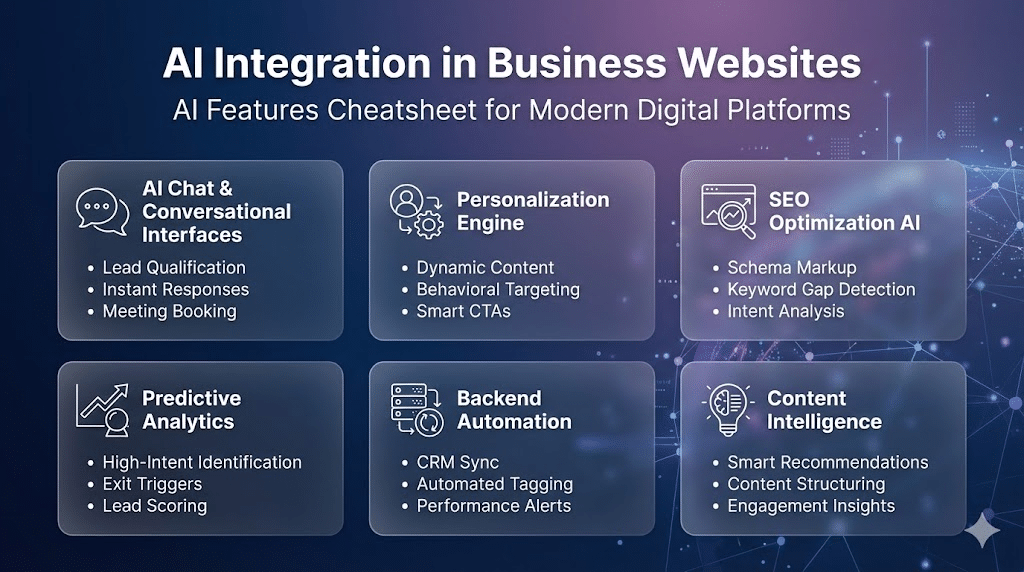
AI-driven chat interfaces reduce friction during the decision process.
Instead of navigating multiple pages, users can ask direct questions and receive contextual answers instantly.
Modern conversational systems can:
These systems improve response speed while reducing dependency on manual sales teams.
AI is also improving how websites perform in search environments.
It can assist in:
When implemented correctly, AI strengthens organic visibility without compromising content quality.
This is particularly important as search engines increasingly prioritize semantic relevance and user engagement signals.
Beyond surface-level features, AI enables deeper data interpretation.
Websites can track behavioral patterns and predict user actions before they occur.
Applications include:
This shifts websites from passive platforms to proactive growth tools.
AI integration is not limited to visible features.
Backend automation improves internal efficiency through:
These improvements reduce manual errors and support scalable growth.
AI integration in business websites is most effective when aligned with measurable goals. It should improve user experience, increase conversion rates, or reduce operational cost.
The objective is not to add visible AI elements for trend value. The objective is to build intelligent systems that strengthen business outcomes through data-driven decision making.
Search visibility in 2026 is engineered during development, not fixed after launch. When SEO is ignored in the build phase, businesses often face structural limits that restrict rankings and slow down growth.
According to BrightEdge, organic search drives 53 percent of all website traffic across industries. For most service businesses, this makes organic search the highest intent traffic channel.
SEO-ready development starts with technical clarity. During the architecture phase, teams must define URL structure, navigation hierarchy, internal linking logic, and mobile responsiveness. These are not cosmetic choices. They directly affect crawlability and indexation.
A strong technical base typically includes:
When these elements are built correctly, search engines can evaluate and rank content efficiently.
Semantic structure is equally important. Modern search systems interpret context and relationships, not just keyword density. Structured data such as service schema, FAQ markup, and organization schema improves visibility in enhanced search results and supports AI-driven search features.
Content planning must also be aligned with intent categories. Instead of publishing isolated pages, businesses should define core service pillars supported by related pages that strengthen topical authority. This ensures scalability without weakening internal linking structure.
Performance remains tightly connected to SEO outcomes. Fast loading, stable layouts, and efficient asset delivery improve both ranking potential and user engagement metrics.
When SEO considerations guide development from day one, the website launches with structural strength rather than requiring corrective optimization later.

Modern website development in 2026 is not only about performance and design. It must also support business continuity, future growth, and operational stability. A website that cannot scale or remain secure becomes a liability over time.
Security breaches are no longer rare incidents. According to IBM’s Cost of a Data Breach Report 2023, the global average cost of a data breach reached $4.45 million. For businesses, this highlights the financial risk of weak infrastructure and outdated systems.
Security should be built into the architecture, not added after deployment.
A secure website foundation includes:
For service businesses handling customer data, these measures protect trust and brand credibility.
Headless or decoupled architectures can also reduce exposure by limiting direct access to backend systems. However, implementation discipline remains essential regardless of technology choice.
As traffic increases, infrastructure must handle demand without performance degradation.
Scalability planning includes cloud-based hosting, CDN integration, load balancing, and database optimization. These components allow websites to manage traffic spikes from campaigns or seasonal demand without downtime.
Businesses investing in paid ads or product launches cannot afford outages during peak activity. Scalable architecture protects revenue during growth phases.
Maintainability determines how easily a website can evolve over time.
Clean code structure, modular design systems, and documented development practices reduce dependency on individual developers. This ensures updates, redesigns, and feature additions can be implemented without rebuilding the entire platform.
Content management flexibility is also critical. Teams should be able to update content, publish new pages, and adjust messaging without complex technical processes.
A modern website should support growth for years, not require full reconstruction every two to three years.
Security protects the business. Scalability supports expansion. Maintainability ensures operational efficiency. Together, these pillars define sustainable website architecture in 2026.
Website development in 2026 is no longer about visual appeal alone. It is about building a performance-driven digital asset that supports growth, visibility, and operational efficiency.
Speed influences conversions. UX shapes trust. Architecture determines flexibility. AI strengthens engagement. SEO drives qualified traffic. Security protects long-term credibility.
When these elements are planned together, the website becomes a structured growth system rather than a static marketing page.
Businesses aiming for premium positioning must treat development as a strategic investment, not a design expense.
A modern website should load fast, communicate clearly, scale reliably, and adapt to future demands without structural limitations.